










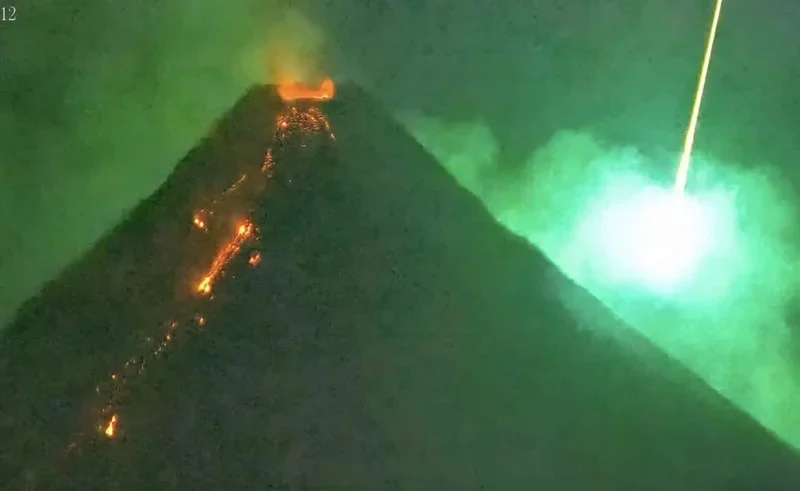
The video was so spectacular, and so movie-esque, that it took the internet by storm Monday night. The video footage, which was taken during a time of volcanic activity, seemed to show a bright celestial body falling from the sky right into the erupting peak of Mount Mayon, in the Philippines.
The clip quickly spread all over social media platforms—including X, TikTok, and Instagram—and was the subject of many speculations internationally. Was there really a meteor that hit Mayon Volcano, or was it a grand illusion of perspective.
With millions of people discussing the dramatic images on social media, scientists and state volcanologists have gotten into the act to distinguish between fiction and astronomical reality. The real truth about the amazing cosmic coincidence.
The Viral Monday Night Video: Cosmic Collision or Optical Illusion?
It was an unusual sighting that the official Lignon Hill monitoring camera recorded on Monday night at exactly 10:33 PM local time May 25th, 2026. A massive, blazing green fireball meteor, streaking on a sharp, vertical path, directly behind the volcano’s silhouette in the night sky, was actively streaming the eruption of Mount Mayon when it started, low in the atmosphere.
The camera angle was ideal, giving the impression that the glowing rock was falling into the active crater in the manner of a dart. The news was immediately picked up in the press and on social media as a literal space rock landed on one of the world’s most active volcanoes.
State Volcanologists Issue an Official Fact Check
As public anxiety and misinformation mounted, the Philippine Institute of Volcanology and Seismology (PHIVOLCS) quickly reviewed its data network to investigate the claims.
PHIVOLCS Corrects the Initial Speculation
Although it was initially believed the object could have landed on the northern slopes, a full multi-angle scientific analysis quickly dismissed that idea. PHIVOLCS issued an official statement within hours that the meteor did not touch the mountain.
State scientists found no physical impact in a comprehensive examination of data from seismic sensors, infrasound monitoring stations, or secondary camera feeds in the region. State scientists found there was “absolutely no physical impact” in a comprehensive examination of data from seismic sensors, infrasound monitoring stations, and secondary camera feeds in the region. In fact, the green fireball meteor was confirmed to have fully burned up and broken up well high in the atmosphere, miles away from the ground.
Why Did the Meteor Turn Bright Green?
This bright green fireball caused concerns about the color of the fireball for many viewers on social media. This is a characteristic color for the presence of magnesium in space rocks, astronomers say. The meteor entered the Earth’s atmosphere at high speeds, generating tremendous heat as it burned up and freed the ions of the surrounding air to produce the bright green flash.
Big travel updates and viral stories—discover what’s trending now.
What Changed In Pattaya Nightlife Rules?
Look into new regulations affecting bars and venues.
How Can Banten Residents Stay Alert?
Check out smart app tools for earthquake updates.
How Can Travelers Get Free Entry?
Discover Sri Lanka’s latest visa fee-free travel move.
Why Is Benedict Cumberbatch Trending Today?
See the viral moment sparking online discussions.
Can You Fly Delhi To Hanoi Cheaply?
Find budget-friendly flight details for summer travel.
Inside Mayon Volcano’s Ongoing 2026 Eruption Status
The burning up of the meteor in the air does not imply that Mayon Volcano is inactive. The viral video was so arresting because it simultaneously captured two extremely powerful phenomena, not related to each other.
Active Danger Zones and “Uson” Currents
World famous for its iconic near-perfect cone form, Mount Mayon is in high volcanic alert. PHIVOLCS is at Alert Level 3 for the region. Meanwhile, on the same night the meteor shower lit up the sky, the volcano produced dangerous pyroclastic density currents (locally known as uson) in the gullies of Mi-isi and Basud.
Safety Warning: These fast-moving, superheated clouds of gas, ash, and volcanic rock present extreme hazards to life. Local authorities continue to enforce a strict ban on any human entry within the 6-kilometer Permanent Danger Zone (PDZ).
FAQs
Did a meteor actually hit Mayon Volcano during the eruption?
No. Official tracking data from PHIVOLCS confirms that the meteor disintegrated entirely while still in the upper atmosphere and did not strike the volcano’s slopes.
How common is a green fireball meteor?
Meteors enter Earth’s atmosphere daily, but large, bright fireballs are relatively rare to capture on camera. The green hue indicates a high concentration of chemical elements like nickel or magnesium burning up under friction.
Is Mount Mayon still dangerous right now?
Yes. Mayon is under Alert Level 3 unrest, experiencing active lava effusion, rockfalls, and hazardous pyroclastic flows (uson). The 6-kilometer permanent danger zone is strictly closed to the public.