









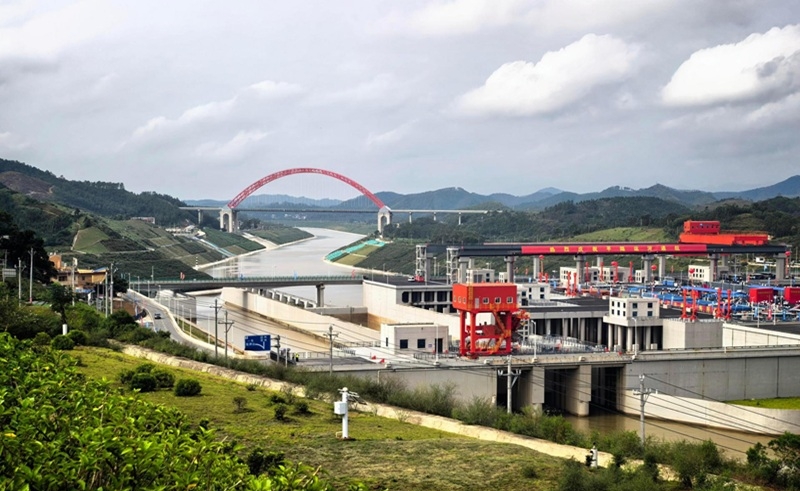
The Pinglu Canal, spanning a distance of 134.2 kilometres between the Guangxi city of Nanning and the Beibu Gulf, was opened to commercial traffic on 16th Sept 2026. The project cost 72.7 billion yuan and will enhance the New International Land-Sea Trade Corridor and provide an entry point for Southwest China.
A Major Logistics Shortcut
The canal could divert freight flows for Chongqing (Sichuan), Yunnan and Guizhou. Cargoes that used to run over 560 km eastwards down the Xijiang River to Guangzhou can now run southwards down the river towards the Gulf of Tonkin. The size of the waterway is based on the water carrying capacity of vessels up to 5,000 tonnes.
It is expected to bring about a 18%-30% cut in logistics costs between the interior of China and the ASEAN market, the shorter route.
Beibu Gulf Port Gains a Bigger Role
The canal enhances the modern port functions of Beibu Port.The canal further makes Beibu Port a modern multimodal port. More cargo from inland shipping and distribution will boost trade across Guangxi and link Southwest China to ASEAN markets.
New China-ASEAN Trade Flows
The project may help to facilitate better bilateral trade. New energy materials, electric vehicles, equipment and fertilizer from Southwest China can directly reach ASEAN.
Exporters from ASEAN may have more efficient channels of market access into China in the western part of the country. Another possible entrance for the corridor is for durian, palm oil, and seafood, which are other agricultural products.
Supply Chains Could Follow
Reduced transport costs can impact factory, warehouse and assembly placement. The canal will promote more cooperation between suppliers in ASEAN countries and manufacturing bases in Guangxi and Southwest China with the upgrade of the CAFTA 3.0. It also runs parallel to the China-Laos Railway and China-Europe Railway Express.
What Does It Means for ASEAN Businesses?
Another link for ASEAN firms into China’s southwest interior is the Pinglu Canal which might enhance their links in sourcing, distribution and market access.
Ultimately, its long-term effects would be influenced by freight volumes, port capacity, frequency of services, and the changes in companies’ supply chains. However, the canal is still seen as an important infrastructure project, which could further enhance the connection between China and the ASEAN region.
FAQs
What does’ Pinglu Canal’ refer to?
The Pinglu Canal, 134.2 km long from Nanning in Guangxi to the Beibu Gulf, is a waterway created for this purpose.
What year was it started?
Commercial service opened up on the canal on September 16, 2026.
What impact would it have on the trade between China and ASEAN countries?
It might help to shorten the freight routes, lower the cost of freight and improve transport links between Southwest China and ASEAN markets.
More ASEAN stories worth exploring.
What Could Marcos’ BRICS Role Mean?
Check out how the India summit could shape Philippine ASEAN leadership.
Can ASEAN Finally Close Haze Gaps?
Find out how stronger enforcement could emerge from Da Nang.
Could Vietnam Reshape ASEAN-Russia Economic Ties?
Uncover five priorities driving Vietnam’s regional economic push.
How Is ASEAN Expanding Regional Connectivity?
Explore infrastructure, digital links and new global partnerships.
Why Must Global Powers Watch ASEAN?
See why ASEAN remains important to major world powers.