
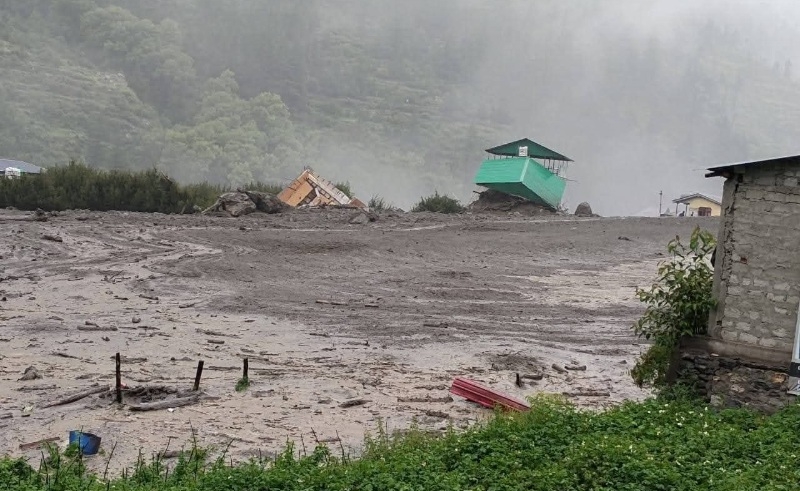
Four people are dead and about 100 others are missing as a fast-paced sludge smashed into India’s Himalayan region on Tuesday. A cloudburst has been identified as the potential cause of this disaster that happened in the state of Uttarakhand.
The Indian Meteorological Department has noted that extreme rainfall had been recorded in the mountainous region, including Uttarakhand. State chief minister Pushkar Singh Dhami said the area had been hit by a cloudburst before the disaster happened in Dharali.
A cloudburst can be quite a complex process. But meteorologists in India relate this situation to a concentrated area of 30 square kilometres or less and that rain should be falling at a rate of 100mm or more per hour.
They tried to run… but the flood came too fast. People below stood no chance.
— @DesiSheikh (@vasha3911) August 5, 2025
Official toll says 4 dead — but over 50 are missing. Locals fear the number is much higher.
Indian Army is on the ground.
#Uttarkashi #uttarkashicloudburst#Uttarakhand #Dharali #cloudburst pic.twitter.com/Sy5v6fTXru
Uttarakhand flash floods: Is climate change not responsible?
The Indian Defence Minister, Sanjay Seth, has confirmed that 4 people have been killed in the Uttarakhand flash floods. But officials fear the number could rise as about 100 people are still missing, including multiple soldiers.
Cloudburst has also been implicated in one of India’s most disastrous floods in history. In June 2013, Kedarnath in the state of Uttarakhand experienced a perilous disaster that killed more than 6,000 people, according to a UN report.
Read Also: Indonesia Floods and Volcano Many dead, Search Continues
But is climate change not responsible? One study into the Kedarnath floods has found that more than half of the rainfall is possibly linked to increases in greenhouse gases and aerosol particles in the atmosphere, reported The Guardian.