

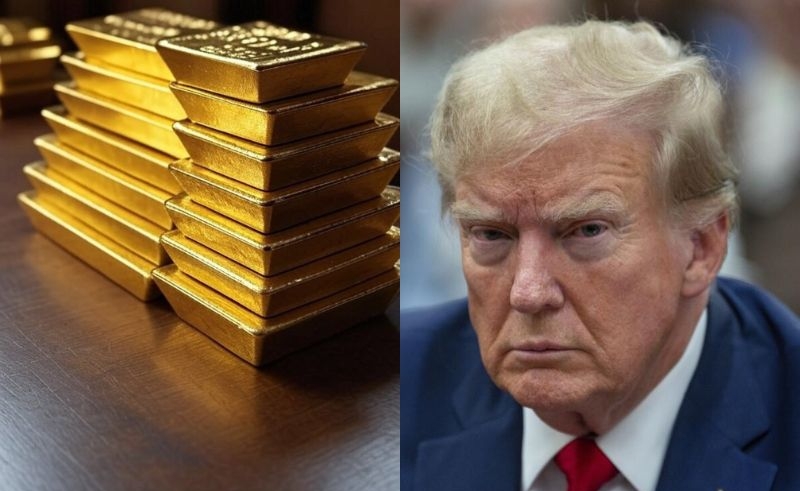
Asia at the Epicenter of the Gold Shock
The April 2025 tariff announcement by U.S. President Donald Trump sent immediate tremors across Asian markets, especially in countries heavily involved in gold trade and consumption. Unlike previous rounds of economic policy maneuvers that impacted the West more directly, this time, the brunt of the disruption was borne by Asia’s largest economies.
The U.S. rolled out a sweeping 10–15% tariff on gold and jewelry exports from countries with trade surpluses, India, China, Vietnam, Indonesia, and Malaysia among them. In retaliation, many of these nations imposed counter-tariffs on U.S. goods, but the real inflationary hit came through the commodities market, specifically gold.
As the world’s top consumers and importers of gold, Asian countries saw prices skyrocket, consumer demand wobble, and central banks scramble to fortify reserves. Within days, gold jumped past $3,100 per ounce, peaking at over $3,500, triggering widespread retail and institutional movement across India, the Gulf, East Asia, and Southeast Asia. The price shock added to inflationary pressure already brewing due to currency depreciation and volatile oil markets.
Wider Asian Inflation and Gold Price Response
Beyond India, other Asian economies felt the ripple effects of the tariff-induced gold rally.
United Arab Emirates (UAE)
Although technically part of the Middle East, UAE plays a central role in Asia’s gold trade. The U.S. imposed a 10% tariff on refined gold and ornaments. Domestic prices responded:
- May 8: AED 400.25/g
- May 30: AED 399.25/g
- June 13: AED 412.75/g
Dubai’s gold markets saw strong institutional buying, while retail consumers hesitated due to inflation and uncertainty.
China
China increased its gold reserves in direct response to tariff pressure and U.S. dollar volatility. While consumer demand for jewelry softened, the People’s Bank of China continued its large-scale gold accumulation as a hedge against further sanctions or trade shocks.
Vietnam
Vietnam, a rising exporter of handcrafted jewelry and electronics, was caught in the tariff crossfire. Rising global gold prices forced traders to reduce stockpiles, and the domestic price of 24K gold climbed over 4% in May, squeezing middle-class consumers and wedding season buyers.
Indonesia & Malaysia
Both countries, reliant on gold for industrial and religious uses, saw mild but notable surges in domestic prices. Import costs rose sharply due to both global gold price escalation and weakening local currencies, pushing inflation in urban markets.
Gold Price Movements in India Over the Last Three Weeks
India’s gold prices over the last three weeks reflected the global surge and local economic response:
- April 29, 2025: ₹95,316 per 10g (MCX)
- May 6, 2025: ₹98,460 per 10g (24K retail)
- May 12–16, 2025: ₹98,680 per 10g
This 1.5% to 3.5% increase was largely fueled by global price momentum, import duties, currency depreciation, and heightened retail demand. Jewelers responded by raising prices and reducing volume purchases, while urban investors turned to digital gold and ETFs to manage rising costs.
Most Affected Asian Countries by Gold Price Surge (Ranked)
| Rank | Country | Primary Reason | Gold Price Impact |
| 1 | India | 15% U.S. tariff on exports, weakening rupee | +3.5% in 3 weeks |
| 2 | UAE | 10% U.S. tariff on refined gold, investor hedging | AED 400 → AED 412.75/g |
| 3 | China | Central bank buying, trade volatility | Rising reserve accumulation |
| 4 | Vietnam | Tariff exposure, seasonal demand, local inflation | ~4% increase in May |
| 5 | Indonesia | Currency pressure, industrial gold imports | Mild price uptick |
| 6 | Malaysia | Religious gold demand, import inflation | Stable but climbing trend |
Asia Bears the Burden of a Global Gold Repricing
The Trump administration’s aggressive tariff rollout may have been aimed at balancing U.S. trade, but it inadvertently set off one of the sharpest gold rallies in years, one that disproportionately affected Asia. As the economic center of global gold consumption and trade, Asian nations bore the brunt of higher prices, weakened currencies, and inflation.
Read Also: Trump to substantially raise tariffs on Indian imports: India hits back
India and the Gulf saw direct commercial impact, while China and Southeast Asian nations responded with strategic gold accumulation and monetary hedging. From Dubai’s souks to Hanoi’s retail counters, gold’s role as a crisis asset was reaffirmed, though not without consequences for consumers and inflation indexes.
With no clear end to trade tensions in sight, gold is expected to remain a vital economic stabilizer. However, the question now is whether Asian governments and consumers can adapt to a new norm: expensive, strategic, and politically sensitive gold.