


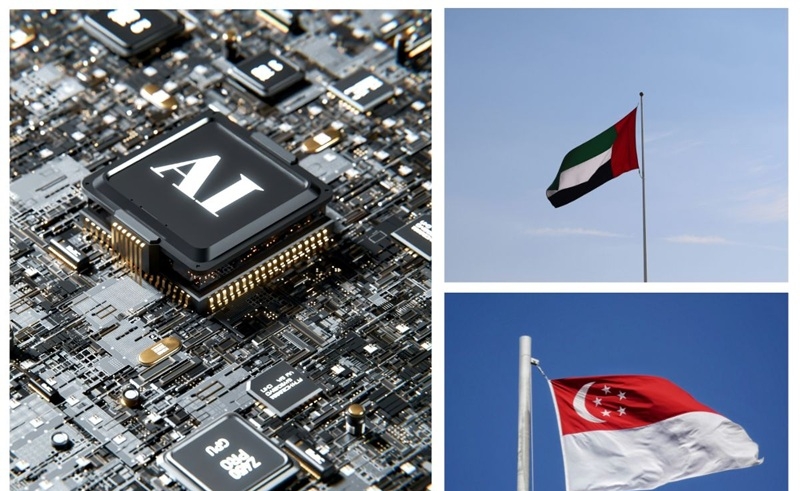
Artificial intelligence (AI) is no longer an invention in laboratories or even tech giants, but it has become a part of the daily lives of employees in most countries. According to a recent report by Microsoft’s AI Economy Institute, the United Arab Emirates (UAE) and Singapore are emerging as the world’s frontrunners in AI diffusion, with nearly 60% of their working-age populations using AI tools monthly. They are the brightest example of the profitability of investing in digital infrastructure and education in the context of long-term orientation because both countries are facing a giant leap over such traditional technological leaders as the U.S. and China in using AI in their daily lives.
An AI-driven Digital Divide in the World
According to the Microsoft report, the UAE, Singapore, Norway, Ireland, and France are ranked in the top five countries in terms of the adoption of AI. Praise is given to the UAE and Singapore in general because they have established powerful digital ecosystems and introduced AI into business and everyday life.
Microsoft defines AI diffusion as the rate at which AI tools and technologies are adopted across sectors and by individuals. According to the data provided by the company, the extensive adoption of AI is strictly linked to the investments made by the countries in the digital infrastructure, education, and connectivity.
Although the U.S and China continue leading the charge in developing AI models, with OpenAI GPT-5 at the top of the list and China DeepSeek coming after, neither of the two is ranked highly in terms of its general use among the general population. Alongside its technological innovation prowess, the U.S. is lagging behind most of its economic counterparts in daily workforce AI interaction.
The results point to the increasing issue: an AI adoption disparity between digitally developed countries and those that are faced with infrastructural or educational constraints. Regions such as sub-Saharan Africa and certain parts of Asia remain backward, especially because of unreliable power, a lack of digital literacy, and a scarcity of data centers. Microsoft observes that the majority of AI data centres are concentrated in the Global North, and the Global South is in a disadvantaged position to access and train superior AI systems.
According to Brad Smith, the president and vice chairman of Microsoft, he stressed that this imbalance needs to be resolved, and he stated, The map looks different now, there is a distinct divide. We aim to contribute to the AI-working experience of all languages and communities.
The Access to Language, Access to the Road Ahead
Another type of inequality that the report throws light on is language bias in AI. Although the world is becoming global, the vast majority of AI content and training data is very skewed to the English language. Though the world population that speaks English as a native language is only 45% of the total population, approximately half of all open web content, including the main source of training data used by large language models, is in English.
The report cautions that this language hegemony places a structural obstacle, and thus, AI tools do not work well with those who do not speak English. To mention but a few examples, Swahili, which has a population of over 200 million, has about 500 times less digital content than German. These differences threaten to leave huge groups of people outside the benefits of AI and indicate the need to create more accommodating models.
In other parts of the world, such as India, there is still a lot of hope. While the country’s current AI diffusion rate is low, its developer community is expanding rapidly — with GitHub reporting that a new developer joins its platform every second. The developer base in India is expected to exceed the U.S. by 2030, which is an indication of the future possibility of faster adoption of AI.
With countries competing to become the first to adopt AI in a responsible manner, the conclusions made by Microsoft put one thing into perspective: namely, access, education, and inclusion will be the determining factor in whether the individual is a beneficiary of the AI revolution or will fall victim to it.
Disclaimer: Stay updated with the lastest news, from politics to business trends, while also catching up on the lastest news in sports covering matches, scores, and tournaments. Explore the latest news in entertainment with celebrity updates, movies, and shows, and don’t miss the latest news in games, featuring trending releases and esports highlights.