









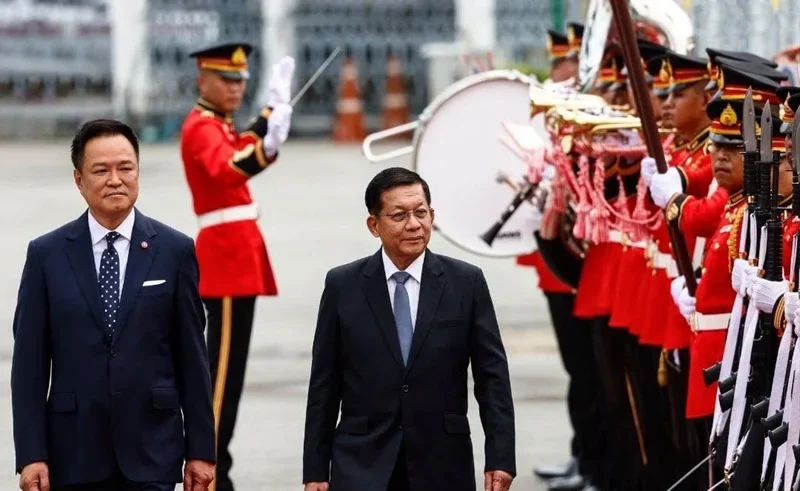
On August 6th – 7th, 2026, President of the Republic of the Union of Myanmar Min Aung Hlaing visited Bangkok on an official diplomatic visit. The visit marks a significant shift in regional diplomacy as it was Min Aung Hlaing’s first time visiting Thailand since he came to power. The summit focused on the signing of MOUs on landmark economic cooperation, strengthening security in the Thailand-Myanmar border region and solving common problems along the border.
Key Highlights of Min Aung Hlaing’s Thailand Visit 2026
The two-day state visit included high-level meetings with the leaders of the Thai parliament, an inspection of the guard of honour and formal bilateral talks at Government House.
The Thailand-Myanmar Business Forum 2026, which took place at the Queen Sirikit National Convention Center in Bangkok, was a key highlight of the event. The forum involved the leaders of business and government to enhance regional trade networks, supply chain resilience and investments from the private sector between the neighboring countries.
Major Thailand-Myanmar Economic MOUs Signed in Bangkok
The summit led to the formal signing and exchange of key bilateral frameworks. The agreements are MOUs for Thailand and Myanmar to facilitate cross-border labor relations and environmental regulation.
Key Bilateral Agreements Overview
- Migration Worker Framework: New migrant worker agreements on labour cooperation and employment conditions to protect legal migration routes.
- Shared Water Resource Management: An agreement to share water quality management for shared, transboundary river systems.
- Space Technology & Earth Observation: Joint projects utilising satellite information to track environmental shifts and farming practices.
Thailand and Japan renewed their commitment to each other on sustainable development and economic growth along the frontier according to the official updates from the Ministry of Foreign Affairs of Thailand.
Stay Updated on Key ASEAN Developments
What Does ASEAN’s New Plan Mean?
Check out the latest five-year ASEAN-U.S. work plan.
What Are ASEAN Travel Rules?
Find the latest visa requirements for visitors.
Which ASEAN Industries Are Growing Fastest?
Uncover industries creating new opportunities in 2026.
What Changed in Thailand Luggage Rules?
Browse the latest baggage screening requirements.
What Does Thailand’s Pink Card Allow?
See key work, travel, and renewal rules.
Reinforcing Thailand-Myanmar Border Security and Regional Stability
They share a 2400kms long land border and both Governments emphasized and focused on a security action plan related to the Thailand-Myanmar borders. Prime Minister Anutin Charnvirakul highlighted that high-level dialogue is still important to address complex security issues.
| Priority Area | Focus of Cooperation |
| Transnational Security | Combating narcotics trafficking and scam networks |
| Labor & Employment | Updating legal frameworks and strengthening migrant worker rights |
| Transboundary Haze | Joint management of agricultural pollution and haze |
| Regional Alignment | Calibrated engagement within ASEAN frameworks |
The topics included suppression of cross-border crimes, online fraud syndicates and illegal drug smuggling. Issues related to the environment such as transboundary agricultural haze were also discussed. Thailand advocates peaceful resolution and regional stability as part of its overall policy of pragmatic engagement, consistent with its ASEAN regional diplomacy aspirations.
FAQs
What were the main outcomes of Min Aung Hlaing’s Thailand visit 2026?
The visit produced key Thailand-Myanmar economic MOUs on migrant worker agreements, river water quality management, and joint space technology applications for Earth observation.
Who hosted the Myanmar delegation during the 2026 Bangkok summit?
Thai Prime Minister Anutin Charnvirakul hosted President Min Aung Hlaing for bilateral meetings, an official state dinner, and joint addresses.
How do these talks impact Thailand-Myanmar border security?
The agreements establish joint security initiatives to curb narcotics trafficking, manage illegal cross-border movement, and dismantle transnational scam centers along the 2,400 km border.