










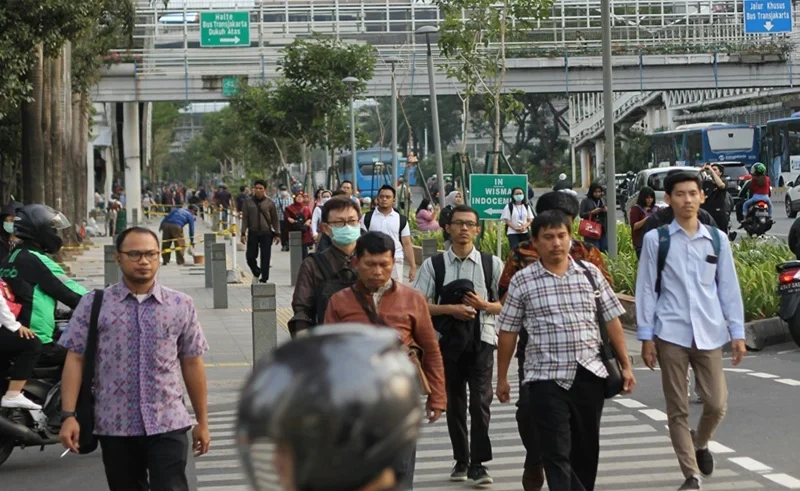
Rizky is 29, works in digital marketing at a mid-sized e-commerce company in South Jakarta, and earns IDR 12 million per month which is well above the city’s minimum wage and in the top quarter of earnings for his age group. He has no savings. None. “My salary has gone up three times in the last five years,” he says. “But every time it goes up, the cost of everything goes up more.” His kosan (the boarding house room he rents near Tebet) costs IDR 2.5 million a month. His daily commute, done by Gojek because the KRL commuter line doesn’t reach his office, adds another IDR 600,000. Food, phone, entertainment, the occasional trip home to Surabaya, the money runs out before the month does. Rizky is simply living in a city whose cost structure has outrun its wage growth.
Wages Are Rising But Just Not Fast Enough
Jakarta’s minimum wage for 2026 was set at IDR 5.67 million per month, an increase of approximately 6.5% from 2025. This is above Indonesia’s headline inflation rate of roughly 4.2%, but only marginally, and the minimum wage is a floor. For workers in the informal sector, which still accounts for an estimated 55-60% of Jakarta’s labour force, the minimum wage is largely irrelevant.
For formal sector workers, salary growth has been genuine in certain high-demand fields. Technology, fintech, digital marketing, and logistics management have seen double-digit salary increases in competitive segments. But the median worker has seen nominal wage increases of 5-8% annually, broadly in line with inflation and therefore neutral in real terms. The wage growth story in Jakarta is therefore highly sector-specific. It is real for the 15-20% of the workforce in high-skill formal employment. For the majority, take-home pay has risen in nominal terms while purchasing power has stagnated or slightly declined.
The Rising Cost of the Urban Basics
The costs that matter most for Jakarta’s middle and lower-middle income earners have risen more sharply than headline inflation suggests, because they reflect specific supply constraints and urban cost structures.
Housing is the first and largest pressure. Rental prices in Jakarta’s central and south city zones have risen 12-18% since 2023. Even in the peripheral zones and satellite cities like Bekasi, Depok, and Tangerang, where the majority of workers who commute into Jakarta actually live, rents have risen 8-12%. A simple, functional kosan in a reasonable neighbourhood near public transport costs IDR 2 million to IDR 3.5 million per month. A proper one-bedroom apartment in a mid-range area runs IDR 5 million to IDR 8 million.
Food costs, always significant given how much of Jakarta’s social and economic life revolves around eating, have risen significantly. Warung prices for a standard Indonesian meal of rice, protein, and vegetables have moved from an average of IDR 20,000-25,000 in 2022 to IDR 30,000-40,000 in 2026, a real-terms increase of 25-30% that significantly exceeds wage growth for lower-income workers.
The Transport Tax
Jakarta’s public transport infrastructure has improved substantially in recent years, the MRT, the Transjakarta bus network, and the LRT have all expanded. But the city’s physical geography and traffic density mean that for most workers, door-to-door commutes still require a combination of modes, with the final leg typically completed by ojek (motorcycle taxi) or private vehicle.
Daily commute costs for a worker living in Bekasi or Tangerang and commuting to central Jakarta run to IDR 25,000 to IDR 50,000 each way using a combination of KRL commuter train and Gojek. Monthly, that is IDR 1.5 million to IDR 3 million, 13% to 25% of minimum wage earnings, just for transport.
Workers who rely on private motorcycles face fuel, maintenance, and occasional toll costs that add up similarly. Those who own cars face the highest transport burden of all, with loan repayments, insurance, fuel, and parking frequently exceeding IDR 4 million to IDR 6 million per month.
Read This Next:
Looking for Jakarta’s newest dining spots?
Explore the latest restaurant openings and trending food destinations across Jakarta in 2026.
Want to attend Jakarta Jewellery Fair?
Check the full guide to the 17th Jakarta International Jewellery Fair and event highlights.
Searching best beaches near Jakarta city?
Discover top beach spots, Thousand Islands guide, and essential travel tips for 2026.
Curious about Jakarta events this month?
Explore exciting events like Digital Detox and comedy showcases happening in Jakarta.
Need family villas in South Jakarta?
Discover hidden comfort stays and best family villas available in Cilandak for rent
Lifestyle Inflation and the Social Costs of Visibility
Jakarta has a particular and underreported dynamic that financial advisors in the city call “gaya hidup” pressure, lifestyle inflation driven by social visibility. The city’s expanding middle class has a strong culture of consumption display with coffee shop culture, ride-hailing convenience, weekend malls, food delivery apps, skincare routines, fashion. These are the choices of people participating in a rapidly modernising urban society. But they add up.
Gojek’s ride-hailing data suggests that average monthly spend on ride-hailing among Jakarta’s app-economy users is IDR 300,000 to IDR 700,000. Monthly coffee shop spending among the 25-35 age demographic averages IDR 400,000 to IDR 800,000 according to industry surveys. Taken together, these lifestyle line items consume a meaningful share of the marginal income that wage growth has provided. In a city where the formal savings infrastructure is not deeply embedded in the financial behaviour of the median young worker, discretionary spending tends to expand to fill available income.
Who Is Saving and How
The workers who are accumulating financial security in Jakarta tend to share certain characteristics. They are typically in formal employment with defined contribution pension deductions via BPJS Ketenagakerjaan. They are deliberately investing a portion of income through mutual funds or stock market products, access to which has been democratised by apps like Bibit and Ajaib. They have a specific savings goal that provides behavioural structure. And they typically earn above IDR 8 million per month, at a threshold where fixed costs consume a declining percentage of income. The remaining majority are surviving, spending, and starting each month with approximately the same financial position as the previous one.
Conclusion
Jakarta’s workers are earning more in 2026 than at any point in the city’s history. This is a genuine achievement of Indonesia’s economic development and should not be minimised. The gap between wage growth and urban cost growth in Jakarta is eroding the financial agency of a generation of workers who are educated, digitally connected, and aspirational. Addressing this gap requires more than minimum wage increases. It requires housing supply reform, investment in public transport that actually reduces commute costs, and financial education and infrastructure that turns income into wealth. Jakarta’s economic story is an impressive one. Its savings story is still waiting to be written.
FAQs
1. What is the minimum wage in Jakarta in 2026?
Jakarta’s provincial minimum wage for 2026 is IDR 5.67 million per month, an increase of approximately 6.5% from 2025.
2. Why are Jakarta workers earning more but not saving?
Rising urban costs have grown faster than real wages for most workers, leaving little room for savings even as nominal earnings increase.
3. What percentage of Jakarta’s workforce is in the informal economy?
An estimated 55-60% of Jakarta’s labour force is employed in the informal sector, where minimum wage protections and formal pension contributions do not apply.
4. What does the average commute cost in Jakarta?
Workers commuting from areas like Bekasi or Tangerang to central Jakarta spend approximately IDR 1.5 million to IDR 3 million per month on transport, depending on mode.
5. How are Jakarta workers investing or saving in 2026?
Those with savings typically use BPJS pension contributions and investment apps like Bibit and Ajaib for mutual fund access. However, formal savings behaviour is most common among workers earning above IDR 8 million per month.