










Introduction
Emma booked a one-way ticket to Bangkok in September 2024 telling herself she’d stay three months. It’s now eighteen months later and she’s renewed her condo lease for the third time. “I thought I was treating myself,” the 31-year-old UX designer from Bristol says, standing on the roof terrace of her Ari neighbourhood apartment, a place she pays £650 a month for, roughly what a damp flatshare in Brixton would have cost. “Now I realise I just live here.” Emma is part of a wave of remote workers who came to Bangkok on what they described to themselves as a long working holiday and found something they weren’t expecting. A city that worked, at a price they could afford, in a place with a quality of life their home country struggled to match. The question of how long this can last is the city’s most interesting current tension.
Why Bangkok Became the Default for Long-Stay Remote Workers
The remote work revolution that accelerated during the pandemic created a generation of location-independent professionals, many of whom spent 2020 to 2023 cycling through the usual nominees like Bali, Lisbon, Mexico City, Chiang Mai. Bangkok emerged in 2024 and 2025 as a destination for a slightly more settled cohort. People past the novelty-seeking backpacker phase, looking for a city with real infrastructure, international connectivity, and an affordable cost of living that allowed actual financial progress rather than just treadmill spending.
The city delivers on several fronts simultaneously. Thailand’s fibre and mobile internet infrastructure is genuinely reliable, average fixed-line broadband speeds in Bangkok are comparable to UK or German averages, and co-working spaces are ubiquitous and well-equipped. International flights from Bangkok’s Suvarnabhumi Airport connect to practically everywhere, at prices that make the occasional European or North American trip financially feasible. Healthcare quality, particularly at the international private hospitals that Bangkok is genuinely world-renowned for, is high and affordable relative to home-country costs. The combination is one that other cities in the region approximate but don’t quite match.
The Cost Arithmetic That Makes It Work
The financial logic of Bangkok for a remote worker earning a developed-world salary in a Southeast Asian cost environment is almost embarrassingly compelling. A one-bedroom serviced apartment in a good central Bangkok neighbourhood costs between THB 18,000 and THB 28,000 per month, equivalent to roughly £400 to £640 or USD 500 to USD 800.
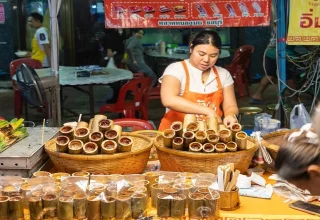
Meals at the city’s extraordinary range of street food stalls and local restaurants cost THB 60 to THB 120 per meal. A monthly food budget of THB 8,000 to THB 12,000 is realistic for someone eating out for most meals, a lifestyle that in London or New York would cost five to ten times more. Monthly transport on the BTS Skytrain and MRT, supplemented by Grab rides for off-route journeys, runs to THB 3,000 to THB 5,000.
A remote worker earning USD 4,000 per month can live very comfortably in Bangkok on approximately USD 1,500 to USD 2,000 per month and save the difference. This savings rate is simply not replicable in the home-country cities from which most of these workers originate.
Why Three Months Becomes Twelve
The decision to extend happens for different people at different moments, but the mechanisms are consistent. The social infrastructure of Bangkok’s remote worker community has developed substantially. Co-working spaces like the many WeWork and local equivalents serve as daily social environments. Online communities for expats and remote workers, organised by profession, nationality, or neighbourhood, facilitate a social life that doesn’t require the years of network-building that establishing yourself in a new home city typically demands.
Visa accessibility has improved. Thailand’s Long-Term Resident Visa, introduced in 2022 and refined in subsequent iterations, provides up to 10-year stays for qualified remote workers meeting income thresholds. The standard tourist visa plus border run approach has given way to more structured pathways that make multi-year stays administratively manageable. And then there is simply the city itself. Bangkok is loud, chaotic, sweltering, and extraordinary. The density of experience it offers creates a daily richness that is addictive. “I got to know the city,” Emma says simply. “And then I didn’t want to leave.”
What Keeps Bangkok From Being Perfect
Thai language remains a significant barrier for those who intend to move beyond the expat-bubble experience of Bangkok. Legal employment in Thailand requires a work permit, and the definitions of what constitutes employment versus freelance work are not always clearly drawn for remote workers technically working for overseas entities.
Health insurance for long-term residents is a recurring anxiety. Thailand’s excellent private hospitals are affordable by Western standards, but chronic conditions, major surgery, or long-term care can become expensive without adequate coverage. Comprehensive international health insurance adds USD 200 to USD 500 per month to the cost of Bangkok living, a significant but manageable addition.
The city’s air quality is a genuine and worsening concern. Bangkok experiences significant particulate pollution, particularly in January to March, driven by agricultural burning in northern Thailand and vehicle emissions. The 2026 burning season was rated the worst in the past five years for Bangkok air quality, with several days of AQI levels categorised as “unhealthy for all groups.” For remote workers considering longer-term stays, air quality has moved up the list of concerns.
More Stories You Shouldn’t Miss
How Do Thai Remote Workers Relax Weekends?
Explore fun activities to unwind and rebalance life.
Why Is Remote Work Booming Across Asia?
Discover key reasons behind Asia’s remote work surge.
Which Cafés Are Best For Remote Work?
Check top cafés in Chiang Mai for productivity.
Where Are Makati’s Top Co-Working Spaces?
Explore the best spaces for remote professionals today.
What Should You Know About Remote Jobs?
Discover essential tips for working online in Indonesia.
What This Means for Bangkok Itself
The long-stay remote worker economy has measurable effects on Bangkok’s residential and commercial geography. Neighbourhoods that have become identified with the remote work community have seen rental increases of 15-22% since 2022, driven partly by higher-spending international demand pushing up what landlords expect to receive. For Bangkok’s own young professional class these neighbourhoods are becoming financially inaccessible in the same way that Shoreditch or Williamsburg became inaccessible to local workers. The Thai government’s approach to this dynamic has been broadly positive but the distributional effects within Bangkok’s housing and services economy are beginning to generate low-level tension.
Conclusion
Bangkok’s remote workers are staying longer than they planned because Bangkok has become, for a specific kind of knowledge-economy professional, the most financially rational and experientially rich city in the world to base oneself. The city’s infrastructure, food culture, community, and cost combine to produce a life that is genuinely superior, on multiple measurable dimensions, to what most of these workers would experience at home. What is less clear is whether Bangkok can manage the success of this formula without pricing out the local middle class that gives the city its authentic character. The answer to that question will determine whether Bangkok remains the remote work capital of the world or simply the latest victim of its own desirability.
FAQs
1. Is Bangkok a good city for remote workers in 2026?
Yes, Bangkok consistently ranks among the top global destinations for remote workers due to its affordable cost of living, reliable internet infrastructure, international connectivity, and quality of life.
2. How much does it cost to live in Bangkok as a remote worker in 2026?
A comfortable lifestyle in a central Bangkok neighbourhood can be maintained for approximately USD 1,500 to USD 2,000 per month.
3. What visa options are available for long-term remote workers in Thailand?
Thailand’s Long-Term Resident Visa (LTR), introduced in 2022, provides pathways for up to 10-year stays for remote workers meeting specific income thresholds.
4. What are the main drawbacks of living in Bangkok long-term?
Air quality (particularly January to March), language barriers, visa complexity, and rising rents in popular expat neighbourhoods are the most frequently cited challenges.
5. Is Bangkok becoming more expensive due to remote workers?
Rental prices in popular remote worker neighbourhoods like Ari, Thong Lo, and Ekkamai have risen 15-22% since 2022, partly driven by international demand from remote workers earning higher foreign salaries.