









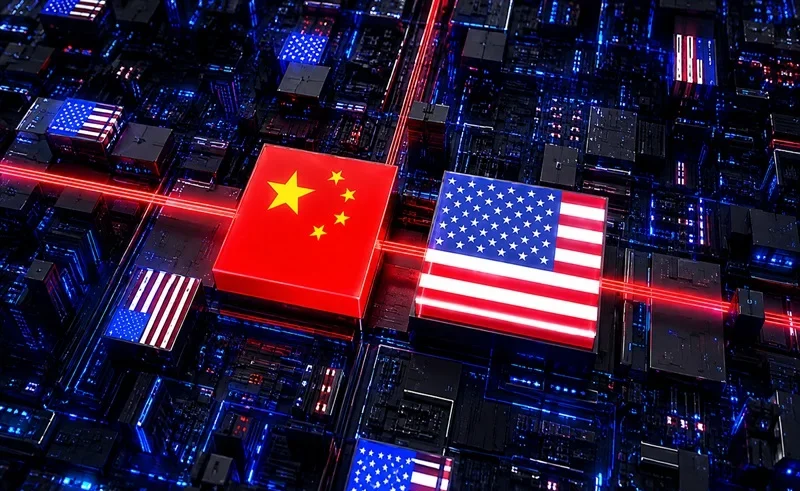
Washington and Beijing are no longer just in a technology race for AI, but in a truly serious competition. From economic productivity to military power, semiconductor supply chains to standards that will drive the operation of digital systems around the world, AI has permeated so many aspects of our lives that we can no longer imagine living without it.
It is a “strategic arms race” or an “AI Cold War” to quote the title, but that doesn’t explain everything. The United States and China are very much intertwined in trade, technology supply chains and global markets unlike in the original Cold War. The competition is not as much about separating as about dominating key parts of the AI landscape.
Battle Begins With Compute
A key advantage Washington has had is to choke China’s access to advanced semiconductors and chipmaking technology. AI models are becoming more powerful, and to power them, the most cutting-edge GPUs and sophisticated manufacturing equipment are deemed essential.
However, there has been an important lesson learned here: hardware constraints do not necessarily hinder innovation. Loopholes can be opened up through smuggling, intermediary markets and continually shifting export-control policies, and Chinese companies are still playing the game for alternative solutions to computing.
China Is Betting on AI Efficiency
Beijing’s answer has been ‘more with less’ more and more. However, Chinese researchers and businesses have been working on algorithms that run quickly, ways to optimize memory usage and synthetic data, which shows that so-called ‘frontier AI’ is not only about using the largest computing cluster in the world.
The importance of this is because a technology blockage may inspire innovation on the technology it is supposed to block. But if the Chinese are getting better and better at training and running models, then the raw compute power might not be as much of an advantage.
AI Is Also a Military Race
The competition is right in the heart of national security. Washington believes AI is key to the development of autonomous defense systems, battlefield intelligence, surveillance and predictive logistics.
China is also developing their own military uses and encouraging a model that integrates civil and military uses. This creates an advantageous landscape in which the intellectual contributions of commercial artificial intelligence firms can rapidly come to have national-security ramifications.
Global AI Standards Battle
The battle isn’t restricted to labs or military bases. It’s also a matter of who sets the rules for the AI economy.
The United States is mainly focused on innovation, international cooperation and safety standards related to democratic governance. Technological development, centralized regulation and the exportation of AI-based surveillance, telecommunications and smart city systems are great features that China brings to the table.
In developing countries the decision is becoming more of an ideological one than one of economics explainable by the question of which technology ecosystem is cheaper and has infrastructure, and more control over national data.
Southeast Asia and Other Middle Powers Matter
This is the way the AI competition is usually portrayed as a two-sided affair between two superpowers, and this wouldn’t be the case if the countries refusing to take a stance were not present.
Increasingly, European states and Middle Eastern economies and Southeast Asian governments are pursuing digital sovereignty with western artificial intelligence services and Chinese hardware or infrastructure as appropriate.
It isn’t just about which country is developing the most sophisticated model, it’s more about which ecosystem becomes more widespread globally.
It Is Not Yet a Traditional Cold War?
The most significant downside to the term “AI Cold War” is that the two nations are still closely tied economically. Yet their technology industries overlap in international manufacturing networks, consumer markets, research ties and key supply chains.
It is this interdependence that makes separation by technology very costly. The future is likely to be characterised by selective decoupling, strategic controls and the competition of specific technologies.
Who Will Win the AI Race?
A multiple winner may be present. American capabilities include frontier research and global talent and semiconductor intellectual property, while China has huge manufacturing capacity, rich data resources, and robust industrial integration.
Who might have the winning edge from one moment to the next. These will all be important at various moments – Compute, Algorithms, Energy availability, Talent and Global adoption.
The true challenge of the AI competition isn’t just to create the “smartest” model. It involves the regulation of technologies, principles and systems that enables the proliferation of AI to be economically and strategically irreplaceable.
More AI Stories You Should Read
How Is Malaysia Shaping Its AI Future?
Check out Malaysia’s roadmap for AI-driven digital transformation.
What’s Next for UAE-US AI Cooperation?
Find out how the UAE-US partnership could shape AI innovation.
Could AI Change How We Date?
Uncover how artificial intelligence is transforming online dating.
Why Is AI Expansion So Significant?
Browse the key factors driving the rapid expansion of artificial intelligence.
Are Schools Ready for AI Jobs?
See why education systems may need to rethink future job preparation.