







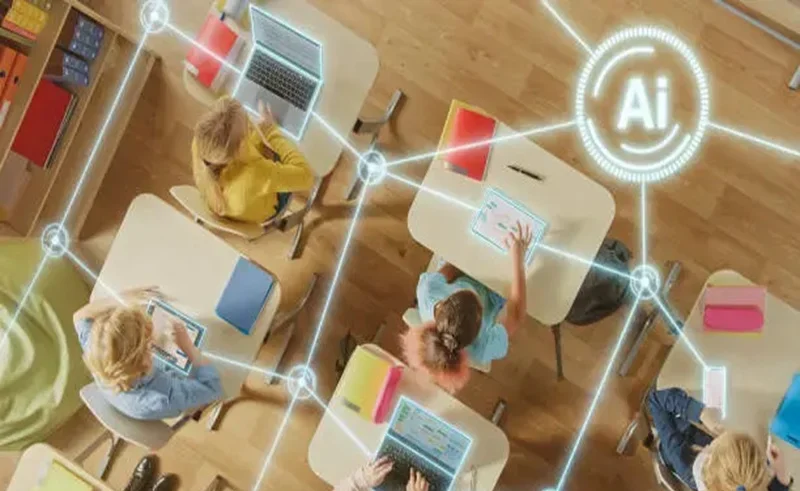
Most of the elements of the modern education system were created to service an industrial economy. Students were schooled on rote learning data, operating within standard procedures and expectations for relatively predictable career paths. It is not as if traditional education has proved lost. Reading, mathematics and scientific knowledge and subject expertise cannot be replaced.
The Workplace Is Changing Faster Than the Classroom
The World Economic Forum has been predicting that much of workers’ essential skills will undergo transformations by 2030. Random people should be the ones talking about that warning to education systems which still teach in a way that is based on static knowledge and restricted career tracks.
Training for an occupation can take years but come time for graduation, the student may find that the role has changed because of automation. As AI tools become more powerful, various sectors within the accounting, customer service, programming and administration, research and content production industries are already undergoing transformation.
But don’t conclude that these jobs will cease to exist. The jobs within them that are transforming. As job titles change, so too must education bring up students.Education should instead train students to adapt to their work, not just just to meet a position description.
Explore the innovations shaping Asia’s smarter future.
How Is AI Transforming Malaysia’s Digital Future?
Check out why artificial intelligence is driving Malaysia’s digital transformation.
Which AI Tools Create Stunning Images?
Find the best AI-powered image generation tools for creative visuals.
Can ChatGPT Really Think Like Humans?
Uncover how ChatGPT performed in a test of human-like intelligence.
How Will Asia’s Workplaces Evolve?
Browse the skills, flexibility, and innovations shaping Asia’s future workforce.
Can Technology Connect Asia More Closely?
See how technology and infrastructure are building a more connected Asia.
From Memorization to Problem-Solving
Traditional assessments tend to be concerned with the capacity to remember the information and repeat it in the setting of the exam. The same method is less relevant if an Artificial intelligence system can instantaneously search, sort and analyze vast amounts of information in milliseconds.
The more important question is if the student grasps what information is important, its reliability and its application. This demonstrates that critical thinking and reasoning and problem solving is at the heart of future ready learning.
Students may need to submit results of AI’s work, but with project-based assignments, collaborative problem-solving, and oral defenses, teachers can determine if the student truly understands the work, or merely copying and pasting output.
AI Literacy Should Become a Basic Skill
Schools should not treat AI merely as a threat to academic integrity. Regardless of whether or not students are being taught the responsible use of AI, they are bound to experience it in their universities, workplaces and everyday lives.
The concepts of using AI models, identifying hallucination and bias in AI-generated responses, safeguarding personal data, and creating effective AI prompts should be part of AI literacy. It’s also crucial for students to grasp the criteria for employing AI and for exercising their own judgment.
The aim should not be to build graduates who blindly believe in or are too afraid to utilize AI, but to become a co-pilot of AI.
Human Skills Could Become More Valuable
AI has been embraced as a new ally in the workforce, the need for skills that are hard to automate might gain in significance. Emotional Intelligence, negotiating, leadership, creativity and judgment, complex communication are still very human qualities.
There’s an algorithm that can make a polished proposal, but it can’t automatically identify the political dynamics on a team or the emotional implications of a tough decision. A school for tomorrow, therefore, needs to have both technical acumen and skill in human judgment.
In an AI economy, do not make arts, communication, teamwork and ethics a second consideration. They might end up being some of the most valuable ways of preparing.
Degrees Must Become Foundations, Not Destinations
The ideas that students need to decide on a career path and stick to it for decades are also outdated. It is more likely in the future that work will comprise more than one industry or role transition, or between roles and technologies.
The ability to learn continuously, then, ought to be taught to the students in universities and schools. As well as the first qualification that students achieve, career resilience could be more important.
Traditional degrees can be complemented with micro-credentials, practical projects and internships, in addition to interdisciplinary study and continuous learning throughout our lives.
Risk Is the Skills Mismatch
The greatest threat is that AI doesn’t take over every job. That education yields students who have expertise which are less desired in the world of employment and a lack of desirable expertise as well.
It may further exacerbate inequality if students from poorer backgrounds are unable to access advanced AI tools or to benefit from personalized learning and career guidance.
In 2035 there are jobs that don’t exist of which schools cannot anticipate nor prepare enough. They can, however, help set up students to adjust themselves when these opportunities arise.
Education Must Teach Students How to Navigate Uncertainty
The best education system of the AI age will not be the perfect crystal ball one that is able to predict the future correctly. They will be those that will make students comfortable with uncertainty.
A student endowed with questioning ability, level of evidence analysis, collaboration with humans and machines, learning new technology, and changing directions will be able to work even when there is a change in jobs.
Change in the central job of education is thus underway. The job preparation process must not be the sole purpose of school. They ought to be setting up their pupils for the ability to be able to be fun, regardless of how the function is defined.