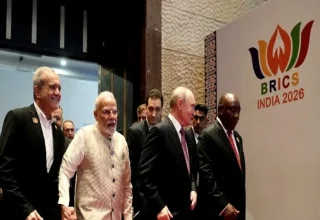


The expanded BRICS enters 2026 with greater economic weight but also greater internal complexity. For India as chair of the group, it is not just about expanding the membership of BRICS but about expanding them as members. To be useful to businesses, investors, and developing economies is implemented.
That demands not only finding alternatives to the US dollar, but also implementable mechanisms that will cut the trade-to-dollar conversion costs, speed up the exchange, and make it more sustainable. The most viable way ahead for India may thus be to transform BRICS into a viable business network.
Interoperability Over De-Dollarization
The best bets for India are payment inter-operability across borders. BRICS can link-up efforts with current national payment infrastructures, instead of trying to build up a costly competition of the foreign and global financial system.
Local currency transactions could become more efficient if platforms like this are interconnected, such as the UPI (India), Pix (Brazil), CIPS (China) and SPFS (Russia). Direct settlement can minimize the need for creating currency conversion, and offer increased versatility to businesses on how they can complete international payments.
More practical de-dollarisation. It does not force countries to discard the dollar, instead it affords countries a secondary choice where local currency is more efficient in conducting bilateral trade.
Critical Minerals and Supply Chains Matter More
Inability to make payments doesn’t make BRICS an economic power. The bloc must also pay attention to the material base of trade energy and critical minerals.
There is an enlarged membership comprising key producers and users of strategic resources. India has an opportunity to take the lead in negotiating cooperation on battery materials, rare earths and other raw materials required for EVs, renewable energy and high-tech/agro industries through the chairmanship post.
Coordination in the supply chain may offer developing economies increased flexibility in the event of Geopolitical shocks and offer more efficient lines of industrial investment.
Energy Cooperation Could Strengthen the Bloc
Another field in which BRICS can add much is energy. It is important to improve coordination between the main energy producers and large consumer markets, to decrease exposure to maritime chokepoints and severe price shocks.
This is especially crucial for India as energy security is a critical issue for inflation, manufacturing and growth economics. Long-term contracts, infrastructure investment and diversified supply contracts would be facilitated by a more robust BRICS energy network.
India Must Manage Internal Rivalries
The main challenge is that BRICS is an unnatural grouping of countries. There are strategic differences between India and China and very different views amongst the members regarding dealings with the economies of the west.
So there is a need to continue the dialogue on common interests in different areas. The promise of digital infrastructure, payment systems, critical minerals, logistics and small business integration are more likely to deliver results than high-minded rhetoric.
A business thinking perspective may also make BRICS more appealing to the non-BRICS members like the UAE and Indonesia.
New Development Bank Needs More Firepower
If financing through local currency significantly increases, the New Development Bank could prove to be another engine for integration. Raise lending in currencies like rupee, yuan and rand to minimise exchange-rate risk to borrowers.
Indians should demand more local-currency liquidity and a significant increase in the percentage of projects raised through local financing that does not involve the dollar.
Implementing BRICS in India
India can not eradicate the political differences within the bloc, but it can make them not so significant and mandate the economic commonalities between the two.
The true challenge for BRICS will not be whether it will raise the most strident hurdles on Western institutions. It will be whether an exporter can be paid more cheaply, whether there is an opportunity for a factory to negotiate for critical minerals, less expensively, and with greater certainty, and whether a developing country can fund the creation of important infrastructure with less currency risk.
If India succeeds in achieving those objectives in practice, the expansion of the BRICS bloc could well evolve into a much more meaningful enterprise than a mere talking shop, a trading bloc based on ‘choice, connectivity and resilience’.
FAQs
Why is India against the idea of having one BRICS currency?
However, India has not gone as far as establishing a common currency; it takes a practical approach of linkages to existing payment systems and local-currency settlements.
How critical minerals might help?
Critical mineral cooperation for BRICS members to obtain supplies of essential industrial raw materials required for batteries, renewable energy and improved manufacturing.
What can be expected from the New Development Bank?
By funding development projects with local currencies and minimizing borrowers’ foreign currency price risks, the New Development Bank can help members achieve the dual objectives of curbing inflation and supporting development.
Explore BRICS and Asia’s New Dynamics
Is Malaysia Rethinking Its BRICS Values?
Find Malaysia’s balancing act within BRICS.
How Did Indonesia Join BRICS?
Uncover Indonesia’s path to full membership.
Why Is Japan Watching BRICS Closely?
See Japan’s response to shifting regional ties.
Could BRICS Create One Currency?
Explore the banknote sparking currency debates.
How Is UAE Advancing BRICS Industry?
Discover UAE’s push for global industrial growth.