









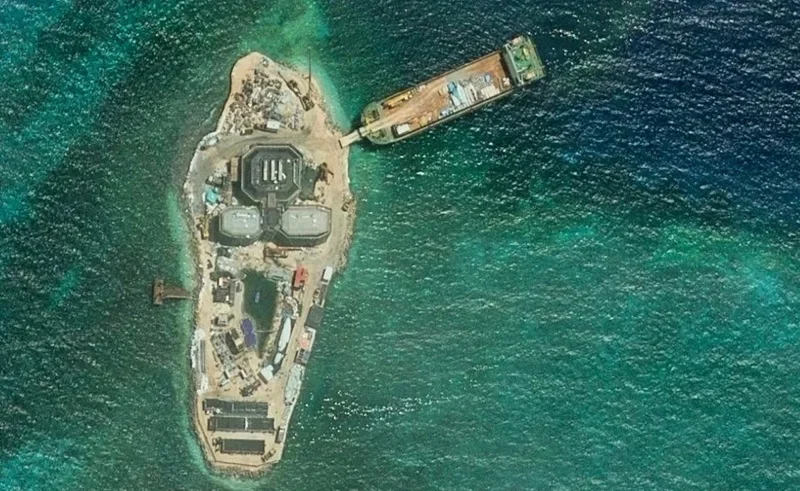
China’s building and military of man-made islands in the South China Sea has changed the strategic scenario of the region. Beijing has transformed the reefs and shoals into permanent military outposts that could be used to host aircraft or naval vessels as well as radar installations well away from the Chinese mainland.
This has more to do than just a territorial dispute. It’s a developing battle for sea-lanes, resources, territory and equilibrium in the Indo-Pacific region.
Why Is China Building Artificial Islands?
China’s island-building efforts have to have several purposes. As the features are physically expanded, China’s capacity to keep a long presence in the disputed areas over its extensive nine-dash or ten-dash line claims become more robust.
The islands are also utilized strategically for power projection. Airstrips, facilities for radars, hardened facilities and deep water berthing areas enable China to operate more distantly from the mainland and respond more quickly to developments that take place in the South China Sea.
The Military Network Behind the Strategy
A number of man-made islands have already entered China’s strategic considerations of its military presence in the region. Airfields, surveillance systems and military installations are found on Fiery Cross Reef, Subi Reef, Mischief Reef, and at Woody Island in the Paracels, and this is another large forward operating site.
Both these facilities form an integrated infrastructure capable of operating reconnaissance, logistics, air operations and maritime deployments. Their geographic distribution also fits into China’s anti-access/area-denial objective that may help make matters complicated for any other military force.
Why does the South China Sea matter?
The South China Sea has significant sea lines of communication and fishing areas and can be expected to hold offshore energy resources.
This will help China proceed to effectively manage its waters and secure its strategic interests. However, the extension of Chinese infrastructure projects in the vicinity of conflictual waters in Southeast Asian states has led to worries regarding the use of fisheries, energy resources and governments’ sovereign rights over the seas.
Legal Dispute Remains Unresolved
China’s conduct continues to be much disputed, but several of its neighbours are rejecting Beijing’s wide claim to the seas. The 2016 ruling by the UN Convention on the Law of the Sea tribunal, which settled another historic rights case, rejected critical parts of China’s claim to historic rights and held that the activities of some of the islands did not provide justification for maritime entitlements.
The decision was rejected by Beijing and it has not backed down from its claims. The conflict had become a legal dispute yet to be settled, and continues to be a significant issue in the region.
Why Is the United States Involved?
The United States and its allies undertake Concern and Protest maneuvers, concern and protest overflights over and in disputed features. Washington states these are a freedom of navigation and an issue with the “excessive claims of the sea.
Beijing sees them as displays of foreign military pressure in its vicinity. Those actions multiply the potential for a routine sea battle becoming a major situation.
South China Sea Tensions to Watch
How Is Philippines Countering China’s Aggression?
Check out the Philippines’ firm response.
Why Is Marcos Criticizing China?
Find out what Marcos said at ASEAN.
Why Did Philippines Suspend Its Survey?
Look into the survey suspension and tensions.
Can G7 Help Resolve PH-China Tensions?
Uncover the G7’s approach to the dispute.
Why Is Philippines Rejecting Any Deal?
See why Manila maintains its no-deal stance.
Flashpoint Built Into the Geography
The Chinese “artificial island” project has generated a new reality with military facilities encroaching into overlapping claims to disputed territories and trade shipping lanes. This complicates the management of the South China Sea with diplomacy only.
For those making claims to ASEAN and/or outsiders, the problem is how to block such coercion without setting the stage for inadvertent conflict. It’s not necessarily the largest outpost that will determine the future of the South China Sea, but whether governments in the area can develop processes that will help ensure the waters don’t turn into a breeding ground for conflict.
FAQs
Why does China want to create fake islands in the South China Sea?
The outposts are part of China’s efforts to beef up its marine presence, boost military activities, enhance surveillance and bolster its territorial claims.
What role do the artificial islands play?
Fiery Cross Reef, Subi Reef and Mischief Reef are among the more important reefs constructed by China in the Spratly Islands, while Woody Island is a significant base in the Paracels.
Does the 2016 arbitration ruling settle the dispute?
The decision rejected key parts of China’s maritime claims, but China is so far resisting the verdict, and the conflict over the issue has not been resolved by the verdict.