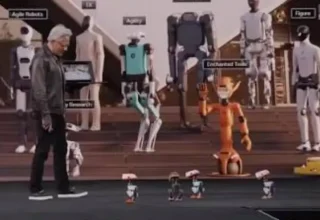










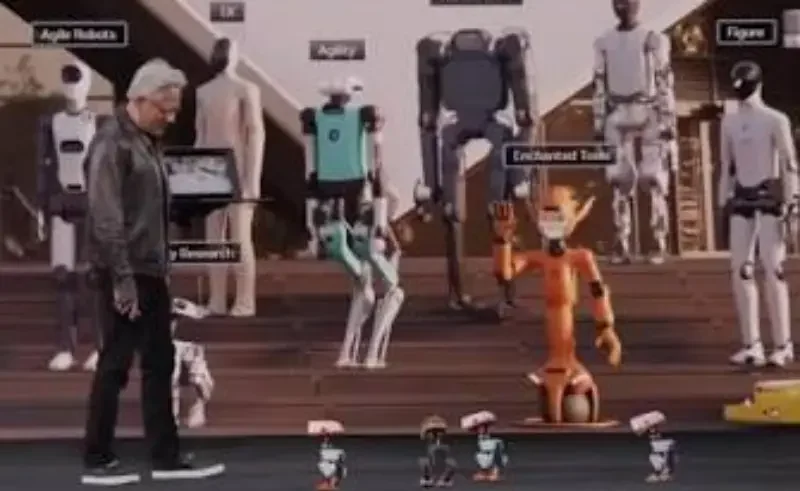
At GTC Berlin 2026 on October 21, NVIDIA CEO Jensen Huang graced the audience with four microscopic AI powered robots named Microducks. The small robots were built by Hugging Face and French robotics companies Pollen Robotics and developed to teach physical movements to robots and give them the ability to follow instructions by learning them.
The ducks fastened with the robots, walked onto the stage hopping, they sat and stood, and they lay down and napped. They played out for the audience just how NVIDIA had shifted its focus towards physical AI, which uses physical AI to enable machines to interact with the real world through simulation and computing.
NVIDIA AI Microducks Steal the Spotlight at GTC Berlin 2026
Huang showcased their talents in his keynote at the Tempodrom in Berlin, which stands about 10 inches tall and weighs less than two pounds each.
NVIDIA AI Microducks Respond to Commands
The robots obeyed, sitting and standing in the instructions given by Huang. The best part was when he invited them to have a nap.
Three other robots then dropped to the ground, and the fourth kept walking a few more steps, then dropped to the others. This ‘messy’ answer made for a good addition of humour but also showed how robotic systems can behave in unpredictable ways.
NVIDIA AI Microducks Highlight Open-Source Robotics
Microduck is intended as an open-source robotics platform for developers, students and researchers that want to try out the robots’ behavior. The user-friendly design enables them to discover the opportunity for physical learning with software, simulation and real world testing.
The project also demonstrates the seamless integration of NVIDIA’s computing solutions with European robotics developers.
How NVIDIA AI Microducks Learn Physical Skills?
The exhibition featured a training process integrating virtual environments and a spiked repertoire of AI models and accelerated computing. Developers don’t necessarily have to use physical test and error methods to test and evaluate robotic movements in the real world, but can use simulation instead to practice and test robot movements before deploying them onto real-world hardware.
NVIDIA AI Microducks Use Isaac Lab and Isaac Sim
Both NVIDIA Isaac Lab and Isaac Sim are designed to simulate their actions in a robotic environment and train their movements. The robots then practiced in virtual settings, and the robots’ developers were able to assess their behaviour and further train them before going into the real world.
It is also equipped with NVIDIA’s Newton physics engine and the use of digital-twin technology to aid in modelling physical interactions as part of the workflow.
NVIDIA AI Microducks Connect Simulation With Hardware
The cloud-based NVIDIA computing was leveraged for training of the robot’s behavior, the demonstration details site says. The skills were then tested on an RTX Spark system to assess the results before transferring the skills to the actual robots.
This method could lessen the need to perform multiple physical tests and allow for the development of greater complex robotic functions.
Why do NVIDIA AI Microducks Matter for Physical AI?
The Microducks are more than just a sideshow demonstration for the keynote speaker. They are a glimpse of NVIDIA’s vision to bring AI to life beyond just chatbots and virtual worlds, turning machines into true agents for navigating and engaging with physical surroundings.
The project would involve creating an open-source robotics platform that includes simulation tools, computing resources, codes, and motors, a combination which could help students and independent developers run experiments with the platform.
The demonstration also showcased the power of Europe’s robotics capability, especially as it relates to solutions working in conjunction with established hardware and AI companies.
FAQs
What are NVIDIA AI Microducks?
They are duck-shaped, small robots built by Hugging Face and Pollen Robotics to test robotic behaviour and actual AI.
How are NVIDIA AI Microducks trained to walk?
They leverage simulations and training equipment such as NVIDIA Isaac Lab and Isaac Sim to experiment and assess movements prior to executing them on real equipment.
What NVIDIA AI Microducks demonstrated at GTC Berlin 2026?
They came on stage and took orders to help prove the possibilities and limits of a physical AI: “Sit,” “Stand,” and “Lie Down!”.
Recommended Reads
What Makes NVIDIA’s DGX Spark 64GB Special?
When Could Anthropic Go Public?
What Should You Know About Surface Laptop Ultra?
How Is the UAE Pursuing AI Leadership by 2031?
Why Is Singapore Linking Seizures to DeepSeek AI Chips?