

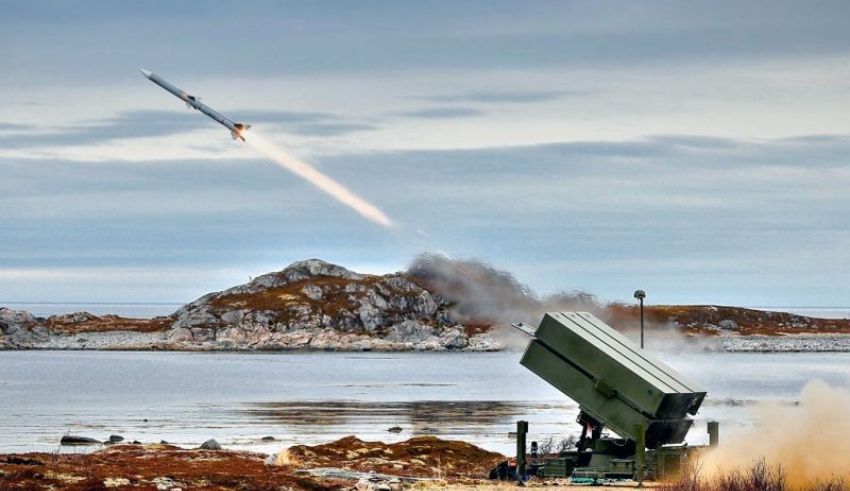
The Indo-Pacific region has emerged as a potential theatre of confrontation between global powers as international relations experience considerable transformations and geopolitical developments. Taiwan has strengthened its defensive capabilities after continued hostilities between the US and China over the island. The National Advanced Surface-to-Air Missile System 2 (NASAMS 2) will be purchased from the United States, according to Taiwan’s Defense Minister Chiu Kuo-Cheng, underscoring Taiwan’s will to uphold its security and independence.
The decision by Taiwan to improve its defence capabilities comes amid rising geopolitical tensions in the Indo-Pacific region. Concerns have been expressed about China’s escalating military exercises near the island, which are seen as an effort to impose its claims to sovereignty. Taiwan has tried to purchase cutting-edge defence systems in reaction to these advances to strengthen its position.
The National Advanced Surface-to-Air Missile System 2 (NASAMS 2) is a collaboration between the American corporation Raytheon and the Norwegian company Kongsberg Defense & Aerospace. Several NATO members already use NASAMS 2 and are renowned for its cutting-edge capabilities. Standard tactical data integration, improved ground radar capabilities, and the capacity to autonomously evaluate and distribute data across numerous platforms are the system’s distinctive characteristics.
During military operations in Ukraine, the NASAMS air defence missile system distinguished itself by effectively intercepting all Russian missiles. This accomplishment confirmed Taiwan’s interest in purchasing the system to improve its air defence capabilities by demonstrating its effectiveness in fending off airborne threats.
The United States also approved prospective arms sales to Taiwan for $440 million because of rising tensions, including the NASAMS 2. The US has a long-standing commitment to aiding Taiwan’s defence efforts under the terms of the “Taiwan Relations Act.” Such purchases, nevertheless, are fiercely opposed by China, which sees them as endorsing Taiwan’s existence as a distinct democratic nation.
China, which hasn’t ruled out using military force to accomplish reunification, poses an increasing military threat to Taiwan. As a result, Taiwan devotes a considerable percentage of its annual budget to maintaining its defence capabilities and purchasing cutting-edge weapons. The island nation aspires to deepen its ties with the US to counteract China’s influence in the region and significantly depends on US support to maintain its security.
Keep Reading

The purchase of the NASAMS 2 system by Taiwan is in line with its strategic objective of efficiently protecting sensitive places, such as military airports and government buildings in Taipei. Taiwan intends to create a multi-tiered defensive system to neutralise potential threats, enhance situational awareness, and communicate with allied forces by incorporating NASAMS 2 into its current air defence infrastructure.
Taiwan’s acquisition of the NASAMS 2 from the US shows how proactively it has responded to the rising geopolitical tensions in the Indo-Pacific area. Taiwan is steadfastly working to improve its defence capabilities in response to China’s territorial assertions and military actions. This action, meanwhile, has not been without controversy because China vehemently opposes any weaponry deliveries to Taiwan, escalating the already-existing geopolitical rivalry between the US and China.
Taiwan’s acquisition of the NASAMS 2 from the US shows how proactively it has responded to the rising geopolitical tensions in the Indo-Pacific area. Taiwan is steadfastly working to improve its defence capabilities in response to China’s territorial assertions and military actions. This action, meanwhile, has not been without controversy because China vehemently opposes any weaponry deliveries to Taiwan, escalating the already-existing geopolitical rivalry between the US and China.