
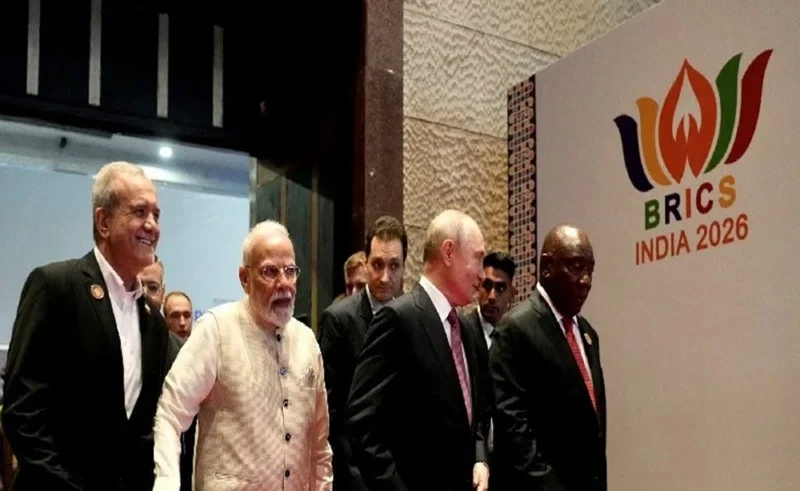
Despite the geopolitical differences between the BRICS members, India has achieved a major diplomatic success at the BRICS Summit 2026, as the group has agreed on the New Delhi Declaration. The triumph is especially significant as the negotiators had been at loggerheads over the West Asia issue, the fight against terrorism and the issue of global governance.
In the context of India’s BRICS diplomacy, finding a middle ground among 11 different members and BRICS’ ability to be a viable forum for the Global South in the future, amid wars, tariffs and strategic rivalries, points to the fact that BRICS can continue to play a relevant role for the Global South.
New Delhi Declaration Puts India’s BRICS Diplomacy in Focus
India is chairing the 18th BRICS Summit on 12-13th September in New Delhi. The meeting is a forum for an enlarged membership, which may have very different strategic interests.
Reaching an agreement on a declaration was anything but automatic in those divisions. Senior negotiators were busy in the days leading up to the summit in an effort to close the gap, especially between Iran and the UAE on the West Asian war language.
The eventual agreement, then, is more than just a diplomatic document. It shows the ability of India to strike a right balance, so that everyone is able to find a common ground to address geopolitical challenges and at the same time not to split the group.
The New Delhi Declaration is 140 points, and focuses on the issues of emerging and developing economies, multilateral reform, economic cooperation and sustainable development.
BRICS New Delhi Declaration Addresses West Asia and Global Trade
One of the most difficult areas was the worsening situation in West Asia.
The statement is “seriously concerned with the tensions in the region” and calls for “maximum restraint,” while highlighting “the protection of civilians and civilian infrastructure. It also restates the concepts of sovereignty and territorial integrity under the UN Charter, instead of a direct reference to countries.
Trade Tensions Also Enter the Spotlight
The BRICS New Delhi Declaration also urges the uninterrupted processes of international commerce, amid the growing uncertainty and challenges faced by businesses and supply chains due to tariffs and geopolitical tensions.
This aligns with the larger strategy of India to make BRICS a forum where geopolitical opposition is not the only agenda; but a platform of economic stability, development and action.
Prior to the summit, India had outlined the key sectors where BRICS could build a collective resilience – food security, energy stability and resilient supply chains.
Terrorism and Global Governance Become Key BRICS Priorities
Counter-terrorism is another important element of the New Delhi Declaration 2026.
The declaration is a condemnation of terrorism and importantly the condemnation statement is for India’s Pahalgam terrorist attack in Jammu and Kashmir. It reinforces the zero tolerance policy with respect to terrorism and international cooperation to combat it.
The addition of a diverse grouping to agree on counter-terrorism language is diplomatically significant for New Delhi as India has been consistently trying to get more stringent language in international forums regarding terrorism.
The official Press Information Bureau has previously highlighted India’s efforts to elevate counter-terrorism cooperation across multilateral institutions.
Global South and UN Reform Gain Momentum
A second theme, also central, is the need to reform institutions established for an international order quite different from what we have today.
The declaration calls for better representation of developing countries in international decision-making bodies and demands reform of international governance forums. It also calls for reforms to the United Nations Security Council, and greater representation of emerging powers in other international bodies like the World Bank and the IMF.
This aligns with the overall trajectory of India’s foreign policy towards the Global South. Instead of this being a “counter-Western” bloc, New Delhi has tried to highlight the aspects of representation and development and reform in existing institutions.
India’s official BRICS chairship document also has an aim of transforming wider representation into real collaboration and of fostering consensus among the growing diversity.
More BRICS & Global Affairs Insights
Could BRICS Pay Transform Global Trade?
Check out how local currency settlements could reshape Global South trade.
Can India Strengthen the Expanded BRICS Bloc?
Find out how India could boost BRICS economic influence.
What Does BRICS Mean for Marcos?
Uncover how the India summit affects the Philippines’ ASEAN role.
Could BRICS Banknotes Signal Currency Unity?
Explore why a symbolic banknote sparked currency unification talks.
What Happens After India’s Indus Rejection?
Look into the possible next steps in the India-Pakistan dispute.
Why the BRICS Consensus Is a Diplomatic Win for India
Consensus is especially valuable, as BRICS is now a much more diverse group after its expansion. It has members such as major powers and emerging economies and the variety of their relationships with security, economic and foreign-policy models.
The challenge was apparent even before reaching the summit. There was the threat of a split in the declaration that could happen if negotiators did not agree on the situation in West Asia.
Hence, at least in the language, securing common language enables India to market its 2026 chairship as a consensus building rather than bloc politics one.
Now the test is implementation. Declarations are the instruments of diplomatic direction but it is in cooperation that results will be seen in the areas of trade, development, technology, energy and institutional reform in BRICS.
Official social media: Updates from the summit can be followed through Prime Minister Narendra Modi’s official X account, @narendramodi.
FAQs
What is the BRICS New Delhi Declaration 2026?
The New Delhi Declaration is the consensus document setting out BRICS positions and priorities covering global governance, economic cooperation, peace and security, terrorism and sustainable development.
Why is the declaration important for India?
It demonstrates India’s ability to build consensus among diverse BRICS members despite disagreements over major geopolitical conflicts.
What does the declaration say about terrorism?
BRICS reiterates its opposition to terrorism and the declaration condemns the Pahalgam terrorist attack.
What does BRICS want to change in global governance?
The grouping supports reforms that increase the representation and influence of developing economies in global institutions, including reforms involving the UN system and international financial institutions.