









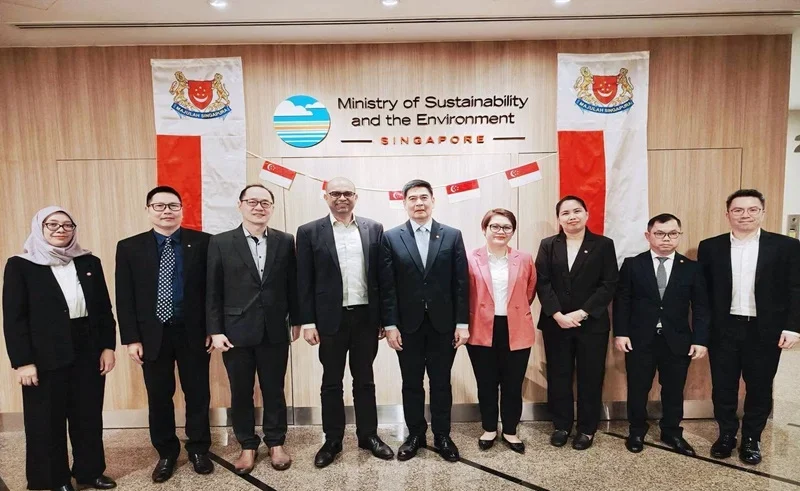
Singapore will take over the ASEAN Chairmanship in 2027 after the Philippines, and Prime Minister Lawrence Wong puts a stronger focus on regional economic integration as his priority. The goal is to enhance the effectiveness of ASEAN as one market, and increase the bloc’s resilience to geopolitical and economic shocks.
Singapore will become Southeast Asia’s Chairman of Ministers in the next phase which will likely affect the future of the digital transformation amongst players in the trade and supply-chain sector as well as businesses and investors in the region.
AI Adoption and Cross-Border Data Flows
Accelerating the deployment of AI in ASEAN, and especially for MSMEs will be a top priority for one of Singapore’s key objectives. The strategy would integrate regional AI resources, workforce upskilling, and technology at a regional level.
Focus will also be on trans-border flows of data, interoperable AI governance, etc. A harmonized framework would help minimize the complexity of regulation across the ASEAN markets for companies doing business in the various markets.
It would be simpler for technology providers, cloud providers, data centers and digital-service providers to expand services across the region without having to contend with ten completely different regulation regimes.
ASEAN DEFA Into Business Infrastructure
Singapore will also be looking at the implementation of the ASEAN Digital Economy Framework Agreement (DEFA). The accord aims for greater consistency in the rules for digital trade and better facilitation for the movement of data, services and electronic transactions in the region.
The implementation of e-invoicing, paperless trade in SIFs and digital identity systems may grow closer and closer. The increased standardization could ease logistics operators and other businesses’ administrative costs to facilitate cross-border e-commerce.
The number one benefit could be greater predictability for companies making a business out of their regional operation. Simplified e-procedures may bring down the elements of friction in entering neighbouring ASEAN markets for smaller businesses.
Supply-Chain Resilience and the ASEAN Single Market
Resilient regional supply chains have become more critical than ever, due to geopolitical uncertainty and changing global trade flows. Singapore is likely to seek less NFB, logistics coordination, and improved intra-ASEAN connectivity.
Other key elements are energy security. Improvements with regard to regional electricity interconnection, such as the ASEAN Power Grid, can assist countries take on energy-price volatility and decrease susceptibility to disruptions in global markets.
The more integrated the ASEAN production network, the more room for manufacturers to leverage on China+1 strategies by spreading manufacturing, warehousing and logistics across multiple Asian economies.
ASEAN Open to Global Investment
There will be no exclusive economic focus on intra-ASEAN integration. On the contrary, the chairmanship will probably centre an open regional economy, in addition to keeping good commercial ties to the United States, China, Europe and the Gulf States.
The multi-vector approach is especially crucial for Singapore, as it plays a significant role in being a global financial and investment hub. Its focus on legal certainty and the protection of private property as well as international arbitration and mediation can remain an asset for multinational firms, who plan on making their Southeast Asian home base there.
What Singapore’s Chairmanship Means for Businesses?
The overall message is that regional integration will also be a business strategy as opposed to a mere diplomatic goal. Businesses with operations spanning across ASEAN countries may gain from having the same digital systems, logistics standards and market rules.
What we’ll see is whether it gets implemented, though. Within the ASEAN economies, infrastructure, regulation and digital readiness vary markedly and will take some time to harmonize.
Hence, the coming of Asia’s next ASEAN chairman in 2027 should be seen as a chance to step closer towards a true single market in ASEAN. A more accessible and connected Southeast Asian economy and one which is less affected by external shocks is the highest potential payoff for companies.
More ASEAN Stories Worth Exploring
Could ASEAN-Brazil AgTech Transform Farming?
Check out ASEAN’s growing agricultural technology ties.
Could Vietnam Face Thailand Again?
Find out what could shape the next showdown.
Why Must Global Powers Watch ASEAN?
Uncover why ASEAN matters to global powers.
How Does ASEAN Balance US-China Ties?
Explore how ASEAN navigates major power tensions.
Why Did Myanmar Reject ASEAN’s Plan?
See why Myanmar rejected the proposed mechanism.