









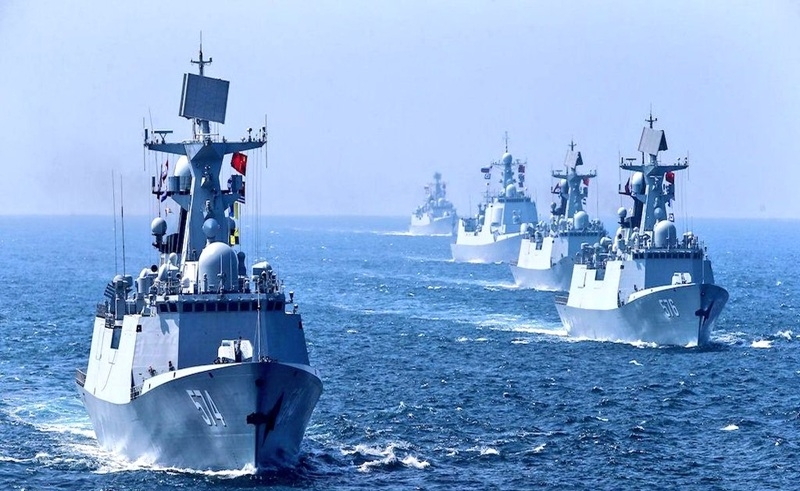
In response to a sudden and highly visible spike in strategic naval operations, the attention of the world has been drawn to Beijing once more. Neighbours and global watchdogs are alarmed by reports of a large-scale Chinese naval flotilla prowling the waters of East Asia. What if this is a move meant for defence, a demonstration of might, or the first step in a grand plan to alter the status quo of the region? It’s necessary to understand what this brazen move actually signifies.
China’s Fleet Movement: A Calculated Signal?
The new fleet dispatch is far from the usual patrol-on-the-spot. The suggestion that it could be a very loud communication to friends and foes by the country concerned is a point of view presented by the people studying this matter. China’s upgrading its presence in the East China Sea, South China Sea, and adjacent maritime routes signifies the country staking its claim of dominance of the region by force of arms.
On the one hand, for many years, the leader in Beijing has been stressing “territorial integrity” and “defensive readiness.” On the other hand, the action embodies the use of state-of-the-art destroyers, surveillance ships, and missile-equipped vessels, proposing a far-reaching, loftier strategic goal beyond the known ones.
Why Now? The Timing Tells a Story
In the game of geopolitics, timing is everything, and the Chinese move is like a trump card dropped right into the middle of changing power structures. Following the ramping up of the trilateral defence pact between the U.S., Japan, and South Korea and the U.S. commitment to the security of the Philippines, the U.S. is clearly leading the way to the Indo-Pacific hot spot scenario, embedding it as the most attacked region in the world.
China’s aggressive deployment could be a countermeasure to such moves as:
- The U.S. militarisation in East Asia is escalating steadily
- Enhanced coordination between Japan and South Korea
- New maritime agreements devised to curb China’s dominance
- Political pressures from within demanding a jingoistic exhibition
The concatenation of these factors converts the message disseminated by China’s team from routine to a strategic, deep-layered move in the game of chess.
Regional Reactions: Anxiety, Diplomacy & Military Alerts
The effects of the disruption have been felt locally and globally. Japan expanded its maritime reconnaissance capabilities quickly after receiving the news. South Korea kept detailed records of the air-sea operations, labelling it a “security-sensitivemanoeuvrer.” Additionally, Taiwan, experiencing heavy pressure from Beijing, saw this as one of the many episodes in an overarching fear-making plan.
Even the closely-knit Southeast Asian community, which is usually very guarded in the expressions of its ideas, is not leaving any doubt about the concerns it nurtures behind closed doors. The root of the fear is this: a single error in the calculation of each other on the water side may escalate to a serious showdown.
Is This a Threat or a Test?
Oracle-like prognosticators are not of a single mind concerning the issue. Some interpreters envision the naval force’s movement as a horrifying gesture foretelling an eager escalatory stance. Still, others dub it merely a “strategic experiment” whereby the Qing empire gauges the speed and rigour of other countries’ counteractions.
Provocations along with Russia in joint drills and border patrols in disputed waters have been Beijing’s modus operandi for the past ten years. All fit the script for this latest action: firmly take control, survey reaction, strategise and decide the next step.
How This Impacts Global Trade & Maritime Routes
The far-eastern seas are not just areas of potential dangers between the different parties, politically speaking–they are the very lifelines for the global economy. Almost 1/3 rd of the world’s seaborne trade is moved through these waters. An increased presence of soldiers, in that instance, can impede sea trade routes, lead to a rise in security costs, and increase the dangers of merchant vessels.
If this situation were to worsen, we would see an outbreak not only of an energy crisis but also in the electronics, automotive, and consumer goods sectors, and hence the whole world economy would endure the aftershocks.
What Happens Next? Possible Scenarios
Strategic Posturing Continues
China is likely to retain the fleet in the area for an extended time as a demonstration of its overwhelming power and influence.
Diplomatic Talks Intensify
Secret talks between the parties involved could be initiated to lessen the risk of tension escalation.
Regional Militaries Boost Patrols
The likes of Japan, Taiwan, and the U.S. may react with the buildup of their forces as a show of strength.
Unexpected Incident at Sea
Impacts or near misses might trigger an unintentional crisis—something everyone would rather not see.
A New Maritime Reality
By deploying a massive fleet across the waters of East Asia, China is essentially changing the game in the region. A power move, a threat strategy, or a mixture of both-it really doesn’t matter. However, what is beyond any doubt is that the maritime equilibrium is undergoing a transformation and that the region is compelled to come to terms with a future that is more than likely marked by uncertainty.
Disclaimer: Stay updated with the lastest news, from politics to business trends, while also catching up on the lastest news in sports covering matches, scores, and tournaments. Explore the latest news in entertainment with celebrity updates, movies, and shows, and don’t miss the latest news in games, featuring trending releases and esports highlights.