









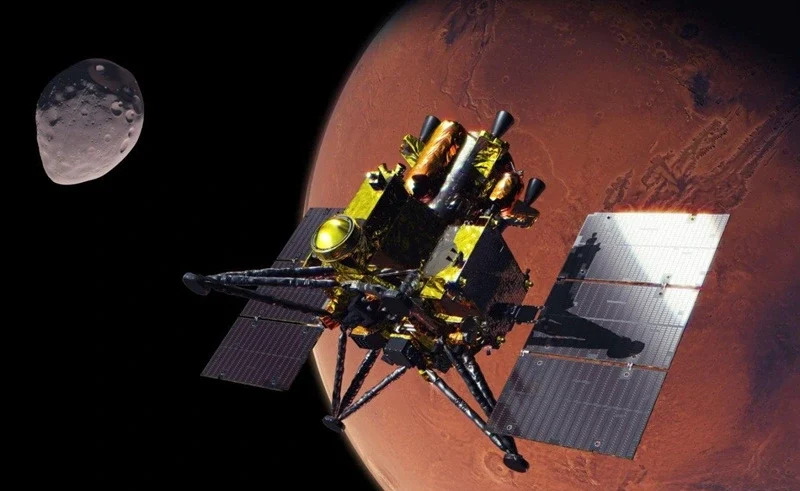
Japan sent its Martian Moons eXploration (MMX) spacecraft towards Phobos on October 20, 2026, starting a five-year effort to bring back the first samples from the Mars system. An H3 rocket lifted off from Tanegashima Space Center at 4:41:03 am Japan time. JAXA confirmed successful separation and initial operations.
The mission will examine both Martian moons, land on Phobos, and collect at least 10 grams of material. Earth return is targeted for 2031.
Key Highlights
- MMX launched aboard Japan’s H3 Flight No. 10 on October 20, 2026.
- JAXA confirmed spacecraft separation and early operating checks.
- The probe is expected to reach Mars in August 2027.
- A French-German rover will examine Phobos before spacecraft sampling.
- Its return capsule should bring samples to Earth in 2031.
What Happened During Japan’s October 20 MMX Launch?
The rocket carried MMX away from Japan’s Tanegashima launch site before releasing it into its planned trajectory. JAXA’s October 20 launch report states that separation occurred approximately one hour, 11 minutes, and 13 seconds after liftoff.
On October 21, JAXA confirmed successful completion of the initial critical operations phase. Solar arrays were deployed and the spacecraft’s orientation established. Mars remains distant.
The 4,480-kilogram probe contains propulsion, exploration and return modules. Only its return module will travel back with the sealed samples.
MMX originally targeted a 2024 launch, but problems with the H3 rocket programme pushed the date back. The October flight demonstrated the H3’s interplanetary launch capability.
Why Is Phobos the Target Instead of Mars?
Phobos is Mars’ larger moon, yet tiny compared with ours. It measures roughly 27 by 22 by 18 kilometres and travels only about 6,000 kilometres above Mars’ surface. It resembles an asteroid, raising a longstanding question: how did Mars’ moons form?
There are two leading ideas. Phobos and Deimos might be captured asteroids, or they might have formed from debris after an ancient impact on Mars. Each points to a different early Solar System history.
Orbital measurements cannot reveal every detail of a rock’s history. Some grains might even be debris thrown off Mars during ancient impacts, although that remains unconfirmed. Mineral and isotope measurements on Earth would provide stronger evidence than photographs alone.
NASA’s MEGANE instrument will measure elemental composition using gamma rays and neutrons. The mission is not searching for living organisms.
How Will MMX Collect Samples From Phobos?
Phobos has very weak gravity. A descending spacecraft could bounce away. JAXA plans two brief surface visits, each lasting approximately two to three hours, after surveying possible landing sites.
Sampling from two levels helps scientists distinguish material altered by space exposure from grains preserved just below the surface. The official MMX science explanation describes two methods:
- Coring sampler: A robotic mechanism digs about two centimetres into the surface to retrieve material beneath the exposed layer.
- Pneumatic sampler: A NASA-provided device releases nitrogen gas to move loose surface grains into a container.
The French-German Idefix rover goes first. Developed by DLR and CNES, it weighs 25 kilograms and will investigate terrain for about 100 days before MMX touches down.
A French infrared spectrometer will examine minerals, while ESA supplies deep-space communication support.
When Will MMX Return Its Samples to Earth?
JAXA’s itinerary requires years of observations and carefully timed manoeuvres.
- 2027: Reach Mars, enter orbit and begin examining Phobos.
- Around 2029: Deploy Idefix and attempt the Phobos landings and sampling.
- 2030: Observe Deimos and depart the Mars system.
- 2031: Release a sample capsule for recovery in Australia.
The planned return capsule, around 60 centimetres across, must survive atmospheric entry before recovery in Australia. The 2031 return remains a target. JAXA expects at least 10 grams for laboratory analysis in Japan. Launch was only the first milestone.
JAXA’s MMX project website carries updates. The hardest tests, including landing and retrieving samples, are still ahead.
FAQs
When Did Japan Launch the MMX Mission?
MMX lifted off on October 20, 2026, at 4:41 am Japan time from Tanegashima Space Center. JAXA subsequently confirmed successful separation and initial spacecraft checks.
Has the MMX Spacecraft Reached Phobos Yet?
No. As of October 24, 2026, MMX is in its outbound mission phase. Arrival at Mars is targeted for August 2027, with landing attempts later.
How Much Material Will Japan Bring Back From Phobos?
JAXA aims to return at least 10 grams of Phobos rock and soil. Both coring and gas-driven collection methods are planned, subject to successful landings.
Why Are Phobos Samples Valuable to Scientists?
Their chemistry could help distinguish between captured-asteroid and giant-impact origin theories. Laboratory measurements may reveal details that orbiting spacecraft instruments cannot resolve with equal precision.
Will the MMX Mission Land on Mars Itself?
No. Its landing target is Phobos, a moon of Mars. MMX will also observe Deimos, while its planned Earth return capsule carries Phobos samples for laboratory analysis.
Explore the Missions Taking Humanity Beyond Earth
1. How Did the UAE Hope Probe Succeed?
Discover how the UAE’s historic Mars mission transformed the nation’s space exploration journey.
2. What Makes Artemis II a Historic Mission?
Explore NASA’s crewed Moon mission and its significance for the future of human spaceflight.
3. How Far Has Humanity Travelled Into Space?
Uncover how Polaris Dawn and Dragon achieved remarkable milestones in human space exploration.
4. Can US-UAE Collaboration Unlock Cosmic Wonders?
Find out how the US-UAE partnership is advancing space exploration through Artemis missions.
5. What Makes the Emirati Mars Mission Extraordinary?
Dive into the UAE Hope Probe’s historic journey and its discoveries about the Red Planet.