









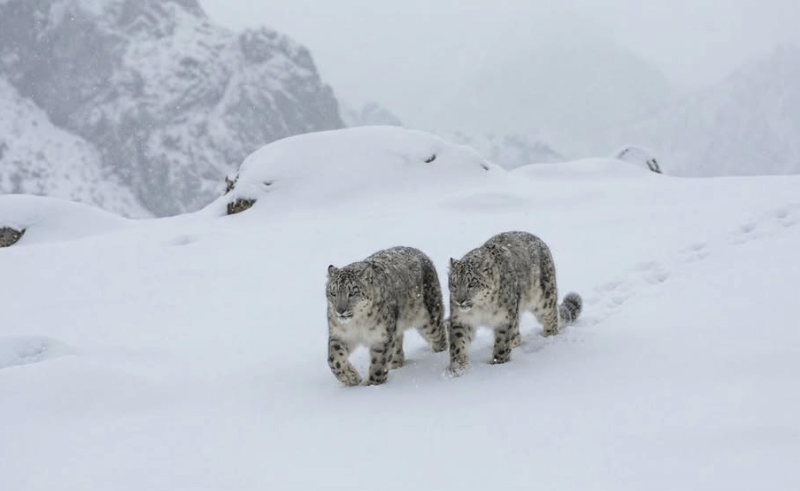
The snow leopard is one of the most elusive predators in the world, and one that is found high up in the icy mountains of Himachal Pradesh commonly referred to as the Ghost of the Mountains. The numbers of these elusive cats have grown by 62 percent in the past four years in a remarkable conservation success story with the population of these cats in the state increasing as per a recent wildlife survey. The population increased to 83 in 2025 (83 snow leopards) as compared to 51 in 2021 which is a big milestone in conservation of wildlife in India.
Yet why was it so dramatically increased? It can be proposed to a mixture of conservation, community involvement, and a scientific follow-up.
Big Data Scientific Surveys.
Improved surveillance and research is one of the greatest contributors to the population increase. The most recent survey employed large scale camera trapping at six locations in Himachal Pradesh which spanned almost 26,000 square kilometres.
These camera traps were used to single out individual snow leopards and trace their pattern. The enhancement of the technology enabled the wildlife professionals to have a better picture of the actual population and the distribution of the species in terms of habitat.
Powerful Conservation Initiatives.
The conservation programs have also contributed significantly to the protection of the snow leopards, particularly through the long-term conservation programs. Activities like Project Snow Leopard aim at conserving the habitat, decreasing human-wildlife interaction and preserving the prey species like blue sheep and Himalayan ibex.
The snow leopards can find safe homes in places like the Kibber Wildlife Sanctuary, the Great Himalayan National Park and Sechu Tuan Nallah Wildlife Sanctuary where they can breed and survive.
Such conservation efforts have helped bring back equilibrium in the volatile Himalayan ecosystem.
Community Involvement Paid off.
Community involvement is another major cause of the population increase. There were local villagers, youth groups, and even women who were remotely located in Himalayan villages who took part in conservation programs and wildlife surveys.
Most communities have shifted their views on snow leopards and with the help of conservation programs, snow leopards are no longer perceived as a threat to livestock. Their familiarity with the area also assisted the researchers in setting up camera traps and tracking wildlife.
Scientists and local residents have found this kind of collaboration to be crucial in the preservation of wildlife in isolated areas.
Growing Habitat and Well Being Ecosystem.
The survey also makes it possible that snow leopards are spreading to new habitats. The appearance of the researchers has been documented outside the conventional safeguarded areas meaning that there is a restoration of health within the ecosystem.
A rise in the prey population like musk deer and Himalayan ibex has also contributed to a rise in the population of snow leopards.
An optimistic future of the Himalayan Predator.
The fact that the population of the Himachal snow leopards increased by 62 percent is more than a number; it is an indicator that conservation efforts are bearing fruits. And as long as these great animals can be monitored, their habitats preserved, and communities involved, their future will be improved.
Nevertheless, scientists caution that climate change and disturbances of the habitat are among the biggest threats. The preservation of the Himalayan ecosystem will be important as long as this iconic species survives.
FAQs
Q1. What is the number of snow leopards in Himachal Pradesh?
According to recent surveys there are approximations that there are 83 snow leopards in the state without cubs.
Q2. What makes the snow leopards the Ghost of the Mountains?
They are very elusive, well blended with the rocky mountain landscapes, and very scarce to find in the wild.
Q3. What are the locations of the snow leopards in Himachal Pradesh?
These are primarily located in the Lahaul-Spiti, Kinnaur and the Pangi Valley, as well as in some of the locked wildlife reserves.