

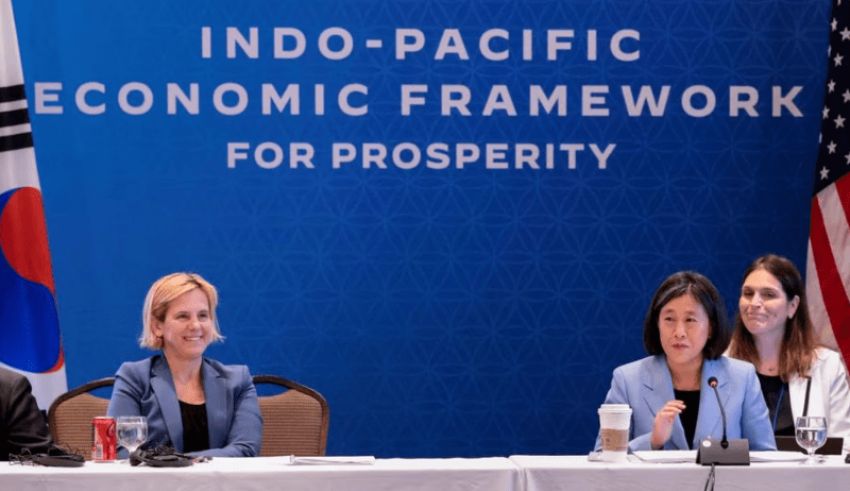
The Indo-Pacific Economic Framework (IPEF), established in May 2023, has drawn much interest since it aims to improve supply chain resilience in the area. A discussion about this agreement’s viability has arisen as academics and commentators analyse its potential effects. The IPEF Supply Chain Agreement’s key components are examined in this article, along with several implementation scenarios and their economic and geopolitical ramifications.
The IPEF’s Objectives and Context
The Indo-Pacific Economic Forum (IPEF), a grouping of 14 member nations in the Indo-Pacific, was established by US President Joe Biden in May 2022 during a Quad Summit in Tokyo. Its four foundations are clean energy, resilient supply chains, fair trade without corruption, and connectivity and digital trade. After the US left the Trans-Pacific Partnership (TPP), the IPEF was seen as the US’ answer to challenge China’s dominance in the area.
Main Features and Skepticism
Although the IPEF Supply Chain Agreement’s complete wording has not yet been made public, early signs point to creating three organisations: a Supply Chain Council, a Supply Chain Crisis Response Network, and a Labor Rights Advisory Board. Programs for enhancing technical support and capability, such as IPEF STEM Exchange Programs and digital shipping pilot projects, have also been suggested. The reaction from the business community and trade specialists has been conflicted globally, though.
Critics claim that the pact lacks binding commitments and meaningful action. The pact favours a process-driven framework above actual actions, casting doubt on its ability to produce noticeable benefits. Concerns about the agreement’s capacity to solve significant issues faced by global supply chains and safeguard labour rights are raised by the lack of legally binding commitments.
Challenges and Market Access
The IPEF Supply Chain Agreement’s inability to give regional states real market access advantages is one of its most critical problems. Southeast Asian and South Asian developing nations that eagerly anticipate exporting their commodities to the United States have questioned the exclusion of debates on market access. Republicans, Democrats, and US labour organisations oppose the Biden administration simultaneously, claiming that tariff reductions will harm domestic employment and manufacturing.
Keep Reading


Comprehensive Nature and China’s Role
The IPEF falls short of the comprehensive nature of agreements like the Comprehensive and Progressive Agreement for Trans-Pacific Partnership (CPTPP) and avoids regional trade agreements like CPTPP and RCEP. As a result, the US offers modest market access and financial incentives to other IPEF partners. The IPEF’s goal to counter China’s geoeconomic influence is complicated by China’s crucial position in Asian industrial and supply networks and its developing market for goods made in the region.
Recommendations for the IPEF
The Biden administration could prioritise negotiations for a significant minerals accord within the framework of the IPEF to increase the IPEF’s efficacy. The US electric car and battery industry would profit while advancing broader security objectives if international corporations were encouraged to invest in, harvest crucial minerals from, and refine them within resource-rich IPEF nations. Future crises must be addressed by ensuring the steady flow of crucial goods and avoiding supply chain interruptions.
The IPEF Supply Chain Agreement’s viability and possible effects have generated a lot of discussion in the media and academia. Experts are less certain of the accord because of its process-driven design and absence of specific benchmarks. Issues present additional difficulties with market access and China’s sway in the area. The IPEF should consider encouraging investment in crucial minerals and prioritise supply chain resilience to close the gap between goals and workable solutions.