
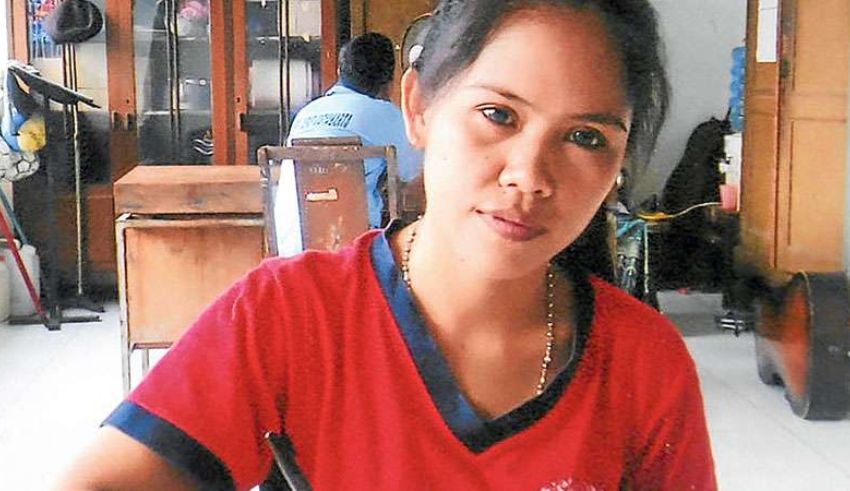
The return of Mary Jane Veloso to the Philippines after over a decade of legal battles and diplomatic efforts marks a significant milestone not only for her and her family but also for the broader context of justice and the plight of Filipino migrant workers. Here’s everything you need to know about her case, the diplomatic journey, and what this decision means for future cases of migrant workers facing similar challenges abroad.
The Story of Mary Jane Veloso
In 2010, Mary Jane Veloso, a Filipino mother of two, was arrested in Indonesia for attempting to smuggle 2.6 kilograms of heroin in her luggage. Veloso claimed she was unaware of the drugs, alleging that she was a victim of human trafficking, with her recruiters misleading her into carrying the illegal items. In 2015, she was sentenced to death by firing squad, creating a wave of international outcry, particularly from her home country, the Philippines.
Despite the overwhelming evidence of Veloso’s victimization by illegal recruiters, Indonesian authorities moved forward with her execution. However, at the 11th hour, in a dramatic twist, the execution was halted after her recruiters were apprehended, which revealed that she had been set up by a criminal syndicate. This pause was pivotal, leading to a long series of negotiations and legal appeals, eventually allowing for her stay of execution and an opportunity to have her case revisited.
A Diplomatic Triumph: President Marcos’ Role
President Ferdinand Marcos Jr.’s involvement in securing Veloso’s return has been crucial. During his state visit to Indonesia in 2022, the issue of her case was brought up during discussions with then-President Joko Widodo. Marcos Jr. emphasized the need to “reexamine” Veloso’s case, highlighting that she was a victim of trafficking, caught in the web of poverty and exploitation.
After extensive diplomatic negotiations and consultations, including many years of legal and political advocacy, the Philippine government and Indonesia reached an agreement. In what was seen as a victory for diplomacy, President Marcos Jr. thanked the Indonesian government for approving the decision to allow Veloso to return to the Philippines, where she will serve her sentence.
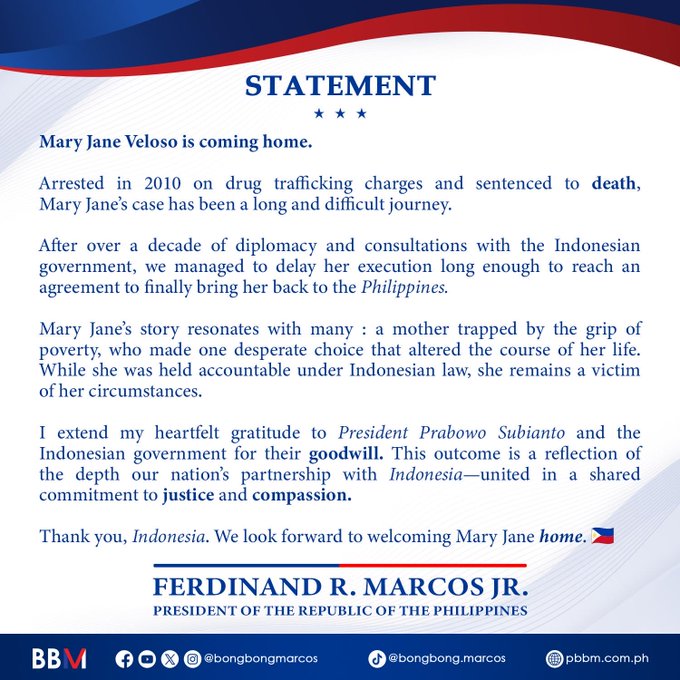
Marcos expressed deep gratitude, stating, “This outcome is a reflection of our nation’s partnership with Indonesia—united in a shared commitment to justice and compassion.” He further noted that this development showed the power of international cooperation and respect for humanitarian concerns, offering a message of hope for other migrant workers facing dire circumstances abroad.
The Impact on Filipino Migrants and International Diplomacy
Mary Jane Veloso’s case serves as a poignant reminder of the vulnerabilities faced by many overseas Filipino workers (OFWs), particularly women, who often fall victim to exploitation and human trafficking. The case has highlighted the need for stronger protections and support systems for Filipino workers abroad, especially in countries with strict legal frameworks, such as Indonesia.
Veloso’s story resonates with many others: a mother caught in a desperate situation due to poverty, who made a decision that would irreparably change her life. While her actions led to her being held accountable under Indonesian law, the Philippine government has consistently argued that she was manipulated and remains a victim of her circumstances.
The legal and diplomatic advocacy for Mary Jane Veloso also underscores the importance of international diplomacy in resolving complex human rights issues. The cooperation between the Philippine government and Indonesia demonstrates how diplomatic channels, when used effectively, can produce tangible results for citizens facing unjust or harsh legal outcomes abroad.
Keep Reading
What’s Next for Mary Jane Veloso?
While Veloso’s return to the Philippines is a moment of immense relief for her family and supporters, the battle is not yet over. The agreement allows Veloso to return to the Philippines to serve her sentence, but the legal process regarding her case is ongoing.
In a radio interview, Department of Foreign Affairs Undersecretary Eduardo De Vega mentioned that the government hopes to have her back “in time for Christmas,” signaling the government’s commitment to expediting the process. Her return will bring closure to a chapter of uncertainty for her and her family, but the case remains a crucial part of broader discussions about migrant rights and justice.
Lessons for Future OFWs and Filipino Families
Mary Jane Veloso’s case has sparked an ongoing conversation about the risks faced by OFWs, especially those vulnerable to trafficking and exploitation. It also raises critical questions about the responsibilities of both sending and receiving countries in protecting migrant workers’ rights. Veloso’s eventual return could serve as a catalyst for policy reforms, ensuring better protection mechanisms for Filipino migrants abroad.
The Veloso case also illustrates the significant role of advocacy groups, local governments, and Filipino citizens in standing up for the rights of those wrongfully accused or facing unfair treatment. Solidarity from both local and international communities proved vital in bringing attention to her plight and delaying her execution.
The Path Forward: A Hope for Justice and Compassion
The return of Mary Jane Veloso to the Philippines is not only a personal victory for her but a testament to the power of persistence and diplomatic efforts. It symbolizes a commitment to justice, human rights, and the ongoing struggle of migrant workers worldwide. This case can serve as a guiding light for future negotiations and interventions involving vulnerable individuals facing injustices abroad.
The Philippine government, in partnership with Indonesia, has taken a significant step toward addressing the broader issues affecting Filipino workers abroad. As more attention is placed on the rights of migrants and the mechanisms available to protect them, cases like Mary Jane Veloso’s could become the beginning of a more humane and just approach to migrant welfare.
Veloso’s story is far from over, but her return is a moment of hope, offering the possibility that justice, when fought for with persistence and compassion, can ultimately prevail.