









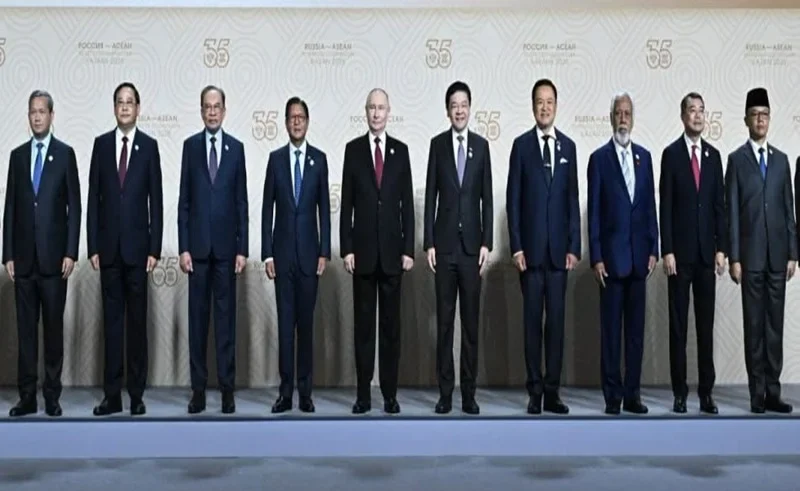
The Kazan declaration 2026 sets a tone for a more pragmatic ASEAN stance on larger powers’ competition. At the ASEAN-Russia Commemorative Summit in Kazan, Russia extended cooperation in energy, civil nuclear technology, cyber security, as well as in trade infrastructure to the Southeast Asian countries.
The proposals are of great importance for the Philippines, Vietnam and Indonesia, as all three nations have increasing needs for energy and infrastructure. At the same time, Russia’s relationships with the US and European and other countries also need to be carefully managed for acceptance of Russian technology and supplies.
Russia’s Energy Offer Comes at a Critical Time
Russia’s proposals for long-term crude oil and LNG supplies arrive at a time when oil prices in the world have become unstable in Asian economies. Moscow has also put forward and encouraged the use of settlement systems in local currency that would reduce reliance on traditional, Western financial systems in bilateral energy transactions.
For ASEAN governments more suppliers means more power to bargain and less exposure to sudden disruptions. But, for countries to be interested in further trade and commerce with Russia, the issues of the sanctions, payment restrictions and shipping risks cannot be ignored.
Philippines: Nuclear Ambitions Meet Strategic Constraints
The Philippines is faced with the greatest opportunity in civil nuclear power. Proposals from Russia featuring Small Modular Reactors may complement Manila’s plans for the diversification of electricity generation and increase in energy security on its dispersed islands.
The issue is a geo-political one. The Philippines has with Moscow deepened its ties in the security sector, so would not want to go deeper with Toronto in energy and nuclear ties without having to make sure that civilian economic cooperation does not taint broader strategic rivalry with Moscow.
Vietnam: Deepening an Established Energy Partnership
Vietnam is not in the discussion in the same way that they’re considering a relationship with Russia, taking into account decades of engagement in energy cooperation. Joint ventures like Vietsovpetro have had a significant part in Vietnam’s offshore oil and gas industry.
Vietnam also has plans in mind to boost its dependable baseload power generation, which might also result in the use of Russian nuclear knowhow. Cooperation with Moscow thus becomes more of an extension than an experiment for Hanoi.
Indonesia: Energy Security Without Abandoning Non-Alignment
Indonesia is surely among countries with the greatest interest in the flexibility of energy partnerships. Being so geographically large, it has long faced issues in the supply of quality power to the remote islands, industrial zone locations and in the area of resource production.
Russian plans for floating nuclear power, which could solve various geographical problems of conventional power, could merit interest. Meanwhile, Jakarta will most likely maintain its ‘bebas-aktif’ (independent and active) foreign policy stance, instead of joining either geopolitical side.
Stay updated on ASEAN’s biggest regional developments!
Why Did Myanmar Reject ASEAN’s Plan?
Check out why Myanmar rejected the special envoy mechanism.
Can ASEAN’s Power Grid Transform Energy?
Find out how submarine cables are connecting Southeast Asia.
Why Is ASEAN Stuck With Myanmar?
Uncover the reasons behind the ongoing diplomatic deadlock.
Why Is China Avoiding Japan’s Meeting?
See why Beijing denied the reported Wang Yi-Motegi meeting.
What Are ASEAN’s Latest Travel Rules?
Track down the latest visa requirements for visitors.
ASEAN’s Bigger Strategy: Keep Options Open
Indeed, the ASEAN’s Kazan Declaration is the epitome that economics doesn’t necessarily need to equal geopolitics. Southeast Asian governments are increasingly seeking to both depend on more than one energy supplier or source and have multiple sources of energy, technology, investment and trade but not relying too heavily on any one major power.
In the eyes of Russia, that is an important opportunity given the region’s economic interests that may sometimes go against the strategic differences. Besides the option represented by Russia, ASEAN can also include Russian offers, but it’s not necessarily about Moscow.
Development of nuclear projects and financing, regulation, and infrastructure takes years for energy contracts. The balanced countries in the ASEAN nations will then have to strike in balancing prompt economic gains against the risks of getting caught by the sanctions and strategic ties and energy security implications.
FAQs
What are the key points of the “Kazan Declaration 2026”?
Kazan Declaration 2026, a result document, is a key document that defines new prospects for closer relationship between Russia and ASEAN that was developed during the ASEAN-Russia Commemorative Summit in the modern city of Kazan.
What would Russia provide ASEAN countries?
Russia suggested it would be looking to expand its cooperation in energy supplies, civil nuclear technology, cyber security, digital security and trade and logistics connectivity.
What impact will the summit have on the Philippines?
In the Philippines, Russian offers could be included in the discussions on nuclear energy and energy diversification but have to compete with Manila’s sound cooperation with the United States.