
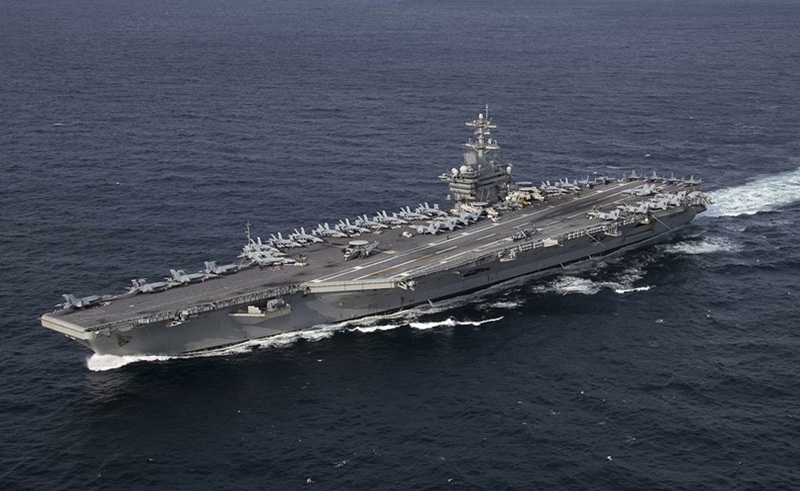
Japan is not always simply placing a new life inside an old shell. Japan is changing the nature of its naval approach, if you will, via the conversion of her Kaga sister ships and JSD Sinpo’s newly built JS Kaju and JS Izumo into STOVL capable vessels.
The vessels are being modified to house the F-35B short-takeoff and vertical-landing fighters, which would for Japan provide mobile airpower, originally a key component of the helicopter destroyers.
A shift is important because it can serve to complement ground-based aviation, as well as enhancing Japan’s flexibility in the Indo-Pacific region.
From Helicopter Carrier to F-35B Platform
The changes involved in Kaga’s conversion involve the flight deck, which is heat-resistant for the type of operations the F-35B would undertake, and a reworked nose and other modifications necessary for the aircraft to operate in F-35B configuration.
These modifications enable fixed-wing stealth aircraft to be flown from a ship built around the helicopters. Joint operations have brought interoperability to the fore with U.S. and British F-35Bs. Japan can use its aircraft platform better in allied air networks.
Why Sea-Based Airpower Matters?
The distributed nature of Japan’s geography is an important factor for Japan’s defense. The Nansei island group lies in the strategically important waters, and in the event of a crisis, fixed air bases also may be at risk of missile attack.
Add airpower that reaches only to the high-tech advanced F-35B. Consequently, the goal is not to create an orthodox carrier fleet, but rather deploy Japanese defense aviation capabilities.
China Changes the Regional Context
Japan’s carrier changeover is happening at the very same time that China is increasing its aircraft-carrier prowess. Beijing’s military branch, naval aviation, has become more significant in the western Pacific with its rising fleet.
Kaga won’t be able to compete with the largest carriers in China. Rather, it’s in the ability to be mobile, stealthy and interwoven into the broader defense capabilities of the country.
Alliance Interoperability Is Crucial
The F-35B further bolsters Japan’s defense ties with its allies. Other aircraft types, training and operating philosophies can aid with greater coordination in the event of a regional contingency.
Interoperability can help to foster a more distributed model of defense in Japan and the U.S., and enhance allied readiness.
Neither Kaga nor Izumo is a match for America’s largest aircraft carriers. They are different in size, capacity of aircraft and missions, so it is not a traditional navy of aircraft carriers, but it is an increase in the number of aircraft that can be equipped for defensive missions.
What Kaga Signals for Asia?
The Kaga conversion is a trend towards mobile and dispersed airpower. Current and future developments in missile systems put greater pressure upon fixed installations, growing interest in alternative platforms of operation.
The change reflects Japan’s changing attitude toward defense. Kaga’s resurrection indicates that Tokyo is putting greater focus on naval aviation, and maintaining its links with the alliance network.
FAQs
What was the reason behind Kaga’s conversion?
The Japanese Kaga class was modified to carry STOVL squadrons of F-35 fighter aircraft for the Japanese Navy, giving it a greater capacity to operate such planes from its ships.
How many F-35s with Variants has Japan ordered?
The Japanese have ordered 42 F-35B.
Is Kaga a full-sized aircraft carrier?
No. Kaga is a “light aircraft carrier” (STOVL) capable ship.
More regional stories to keep you informed.
Why Did The World Ignore Khmer Rouge?
Check out how Cold War politics shaped UN decisions.
Could Severe Haze Return In 2026?
Find key warning signs and peak haze months.
Why Do Superpowers Lose Insurgencies?
Uncover the asymmetry behind difficult counterinsurgency wars.
Could Malaysia-Thailand Energy Ties Deepen?
Explore the new MTJDA deal and its implications.
Can India-China Trade Survive Border Tensions?
See how Delhi separates trade from security.