









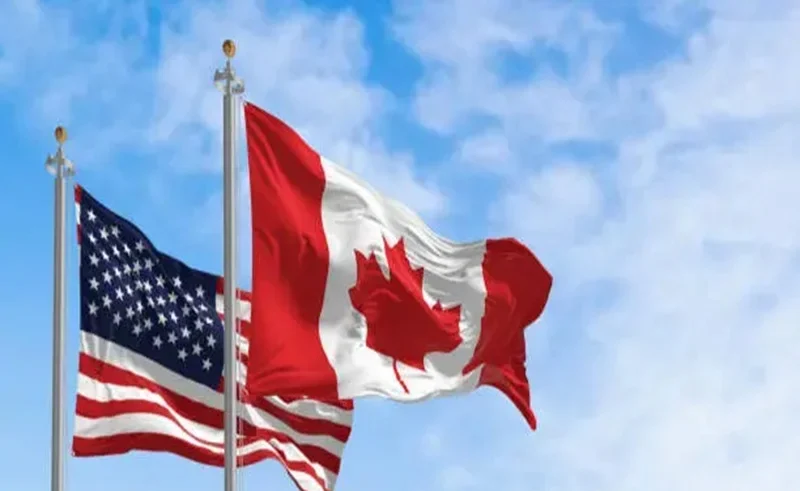
There is also an anachronism in the calculation of powers of North America, in the search for strategic autonomy that Canada is conducting. Canada is on the verge of being separated economically with the world’s largest economy. However, it is for reasons of geography that Canada is an important ally to the United States for its energy security, the defence and supply of its resources in its own continent.
America’s Economic Leverage Is Real
Canada’s economic dependence on the U.S. market is strong. The percentage of Canada’s merchandise exports bound for the United States was approximately 72.5% in 2025, but down from the previous year when the share was 76.3%. Meanwhile, Canada’s exports to non-U.S. markets grew, indicating diversification is already a part of Ottawa’s economic agenda.
This imbalance allows Washington a very strong bargaining chip. Canadian manufacturers, farmers and exporters may feel the impact of tariffs, or border issues or a shift in trade arrangements in a matter of hours. It is particularly significant in the integrated automotive, energy and industrial supply chains.
But Interdependence Limits Coercion
Canada continues to be a significant supplier of energy to the U.S. Canadian crude-oil imports into the United States hit approximately 62% in 2024, highlighting the intricate interdependencies between the United States and Canada in terms of energy resources.
With that reliance comes a change in the calculation. Curbing Canadian exports is thus not only unfair but can also increase American costs. Energy intensive industries, refineries and cross-border manufacturers can’t go on exploring alternatives to Canadian supplies as easily as that.
Geography Works Both Ways
It’s a relationship that extends to the Arctic. For Canadian interests Canada’s land mass is a central part to the security of North America as it is vital to Washington through the cooperation by means of North American defence related agreements.
Geography is therefore a limitation and a negotiating chip for Canada. If the U.S. turns away Canada, it loses its territory, its resources and its influence in continental security.The U.S. can’t turn its back on Canada’s territory, its resources, or its influence on continental security.
Strategic Autonomy Through Diversification
Strategic independence doesn’t necessarily mean economic independence from the United States for Canada. The more pragmatic version of this is establishing enough alternative relationships in such a way that reliance on any one one should not render one relationship as a political liability.
The U.S. isn’t the one to feel the heat, however, as Canada has already taken steps to broaden trade. Exports to non-U.S. markets went significantly up and the significance of the European and Indo-Pacific markets increased in 2025.
All of this diversification is not going to remove the geographic fact of being Canada. But it might offer Ottawa more leverage in negotiations with Washington.
Explore the latest Canada developments.
Could Canada-ASEAN Trade Talks Conclude Soon?
Check out the latest progress toward a November trade deal.
Can Clean Power Boost Canada’s Industry?
Discover how clean energy could support domestic industrial growth.
Can Malaysia and Indonesia Get Visa-Free Access?
Find out the latest eTA eligibility requirements for travelers.
Why Is Canada Attracting Newcomers?
Explore key reasons Canada remains popular for relocation.
Can Canada Meet NATO Spending Goals?
Look into Canada’s defense spending challenges and NATO commitments.
North American Balancing Act
Future relations are unlikely, then, to be contained in the precepts of progressive domination or progressive opposition of the American or Canadian character. Washington has terrific advantages of its own in both the economic and strategic field, but Canada also has its resources, and its geographical position is different.
The actual battle is over negotiations for space. The U.S. could make Canadian strategic autonomy more expensive, and on the other hand Canadian excessive pressure on the U.S. could be detrimental to American economic and security interests.
FAQs
Is there enough economic leverage to be able to squeeze Canada?
Yes. But Canada heavily relies on the U.S. market, affording Washington well-situated economic leverage.
Why is there still something that Canada could bargain over?
Canada also provides valuable energy and natural resources to the United States and is a vital part to the continent’s security.
Does Canadian ‘strategic autonomy’ imply a desire to abandon North American ties?
Not necessarily. Strategic autonomy can, on the contrary, be developed by keeping current partnerships and devising new economic and diplomatic options.