
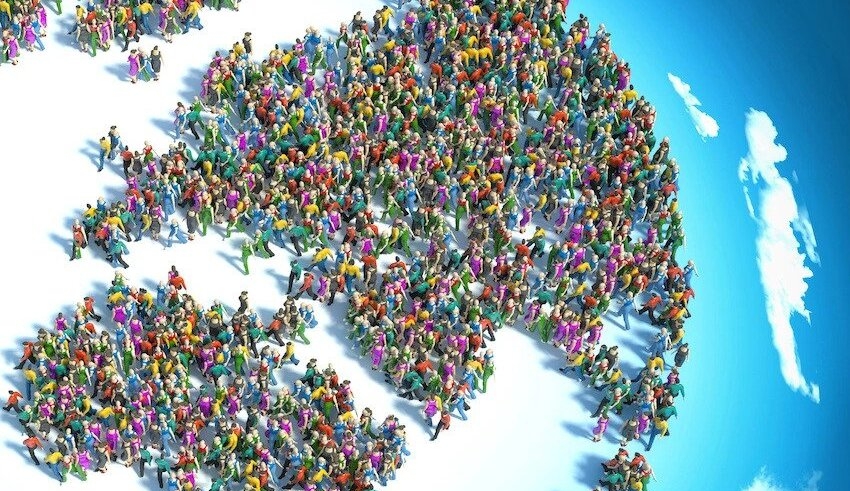
The global population surpassed 8 billion on November 15, according to the United Nations, which issued a warning that places already struggling with resource constraint as a result of climate change may face more hardship.
According to UN forecasts, there will be less food, water, batteries, and gasoline as the global population increases by 2.4 billion people by the year 2080.
Stephanie Feldstein, director of population and sustainability at the Center for Biological Diversity, stated, “Every individual requires fuel, wood, water, and a place to call home.”
According to analysts, African states whose populations are projected to increase the most will face a particularly daunting resource crunch. These countries are also among the most susceptible to climate consequences and in greatest need of climate finance.
According to the Institute for Economics and Peace, sub-Saharan Africa’s population is anticipated to increase by 95% by the middle of the 21st century, from the current 738 million people without appropriate food sources. In an October analysis, the think group predicted that much of sub-Saharan Africa will be unsustainable by mid-century.
Globally, the 8 billion population mark reflects the addition of 1 billion people in the last 11 years.
Reaching 8 billion people is “a sign of human progress, but also a tremendous risk for our future,” according to the director of the United Nations’ population division, John Wilmoth.
Middle-income countries, primarily in Asia, accounted for the majority of this expansion, adding over 700 million individuals since 2011. Next year, India is expected to surpass China as the world’s most populated nation, after adding approximately 180 million people.
However, birth rates in the United States, Europe, and Japan have been continuously dropping. China has similarly wrestled with the legacy of its One-Child Policy, urging families to have a second and even third child while restricting access to non-medical abortions last year.
Keep Reading

Even when the global population hits new heights, demographers report that the annual growth rate has consistently declined to less than 1%. This should prevent the global population from reaching 9 billion until 2037. The United Nations predicts that the population will peak in the 2080s at approximately 10.4 billion people and remain at that level until 2100.
This age of high population increase, which the world has seen for millennia, is coming to an end, Wilmoth explained.
The majority of the 2.4 billion people that will be added to the world’s population before it peaks will be born in sub-Saharan Africa, representing a shift away from China and India.
“On average, African cities will expand,” said Deborah Balk, a demographer at the City University of New York. This will expose millions of additional urban residents to climate hazards such as rising seas.
She stated that, globally, “the coastal zone is disproportionately metropolitan.” About one in ten individuals inhabit the low-lying coastal zone.
Lagos, a coastal metropolis in Nigeria, is projected to become the world’s largest city by the end of the century.
In the coming decades, rapid population expansion and climate change are likely to cause global migration and violence, according to scientists.
Moreover, as humans compete with wildlife for water, food, and space, a larger human population increases the burden on nature. But how much they eat is also crucial, suggesting that politicians might make a substantial impact by legislating a change in consumption patterns.
Between 1990 and 2015, the carbon emissions of the richest 1%, or almost 63 million people, were more than double those of the poorest half of humankind, according to a 2020 analysis by the Stockholm Environment Institute and the non-profit Oxfam International.
Wilmoth stated that the impact of humanity on the natural world has more to do with human behavior than population size.