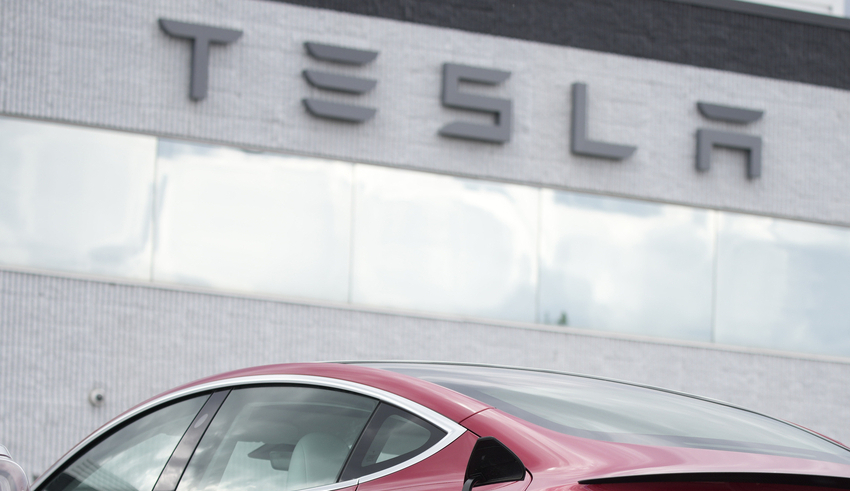
Tesla Inc. will recall more than 362,000 US vehicles to update its Full Self-Driving (FSD) Beta software after US authorities declared on Thursday, February 16 that the driver assistance technology did not comply with road safety standards and might cause accidents.
The National Highway Traffic Safety Administration (NHTSA) stated that the Tesla software permits a vehicle to “reach speed limits or proceed through intersections in an illegal or unexpected manner, which increases the danger of a collision.”
Tesla stated that it disagreed with NHTSA’s assessment, but finally complied with the agency’s January request. The electric car company has already argued with the NHTSA, which has many Tesla investigations open, over various safety concerns and recall requests.
Tesla, whose shares finished at $202.04 down 5.7%, will provide a free over-the-air (OTA) software upgrade. The EV manufacturer stated that it is unaware of any injuries or fatalities associated with the recall problem. The manufacturer reported 18 warranty claims.
The recall affects Model S and Model X cars from 2016 to 2023, Model 3 vehicles from 2017 to 2023, and Model Y vehicles from 2020 to 2023 equipped with FSD Beta software or awaiting installation.
Democrat US senators Ed Markey and Richard Blumenthal said the recall was “far time” and that Tesla must stop exaggerating the capabilities of its automobiles.
This is a new disadvantage for Tesla’s driver assistance technology. Elon Musk has frequently missed his own self-imposed deadlines for achieving self-driving capabilities, which he has promoted as a potential cash cow.
This is an unusual intervention by federal authorities in a real-world testing program that the business believes is essential to the development of self-driving cars.
The recall occurs less than two weeks before the company’s investor day on March 1, at which Musk is expected to tout the EV manufacturer’s artificial intelligence prowess and expansion ambitions.
While Tesla’s Autopilot aids with steering, accelerating, and braking for other cars and pedestrians inside its lane, the firm claims FSD is a more sophisticated technology “intended to give more active guiding and aided driving” under the driver’s active supervision.
By the conclusion of 2022, Tesla reported $2.9 billion in deferred revenue attributable to “access to our FSD features, internet connectivity, free Supercharging programs, and over-the-air software upgrades, mostly on automobile sales.”
Keep Reading
Musk tweeted on Thursday that the term “recall” for an over-the-air software upgrade is “outdated and completely incorrect!”
In the fourth quarter, Tesla issued FSD Beta to virtually all of its 400,000 FSD customers in the United States and Canada, generating $324 million in FSD revenue. IBM stated that it expects to recognize almost $1 billion in deferred revenue once software upgrades are released.
Musk has categorized FSD technology as one of Tesla’s artificial intelligence endeavors.
Musk stated in a May 2017 conversation with members of a Tesla owners club that autonomous driving is “critical” for the firm. That is the difference between Tesla having a high market value and having essentially no value.
The NHTSA started an inquiry into 830,000 Tesla vehicles equipped with the driver assistance technology Autopilot in 2021 in response to a series of collisions with parked emergency vehicles. The NHTSA is examining whether Tesla vehicles effectively assure driver attentiveness. Thursday, NHTSA stated that despite the FSD recall, its “investigation into Tesla’s Autopilot and related vehicle technologies remains open and ongoing.”
Tesla stated that under “some rare scenarios… the function might potentially violate local traffic rules or conventions when performing specific driving maneuvers.”
According to the NHTSA, circumstances where the problem might arise include passing through or turning at certain crossings with a yellow light and changing lanes from specific turn-only lanes to continue straight.
“The system may not appropriately respond to changes in posted speed restrictions or account for the driver’s adjustment of the vehicle’s speed to exceed posted speed limits,” the NHTSA stated.
NHTSA stated that last year Tesla recalled roughly 54,000 vehicles in the United States equipped with FSD Beta software that may allow some models to make “rolling stops” and not come to a complete stop at certain junctions, creating a safety concern.
The improved driving capabilities of FSD, according to Tesla and the NHTSA, do not render vehicles driverless and need drivers to pay attention.
In December, the National Highway Traffic Safety Administration (NHTSA) began two additional special investigations into collisions involving Tesla vehicles, including an eight-vehicle collision on the Bay Bridge in San Francisco in which a driver stated that the FSD feature had malfunctioned.
Since 2016, the NHTSA has started over three-dozen investigations into Tesla collisions in which advanced driver assistance systems were suspected, and 19 fatalities have been recorded.
Read More: Air France CEO says Chinese rivals have “unfair edge” flying over Russia